What Is the Difference Between SPL Token and Token-2022 on Solana?
Solana has two token programs: the classic SPL Token and the extensible Token-2022. Using a real mainnet test, we compare their cost, metadata, extensions and DEX support — and explain which one to pick for a new token.
 Antonio Vaganovs·Published ·7 min read
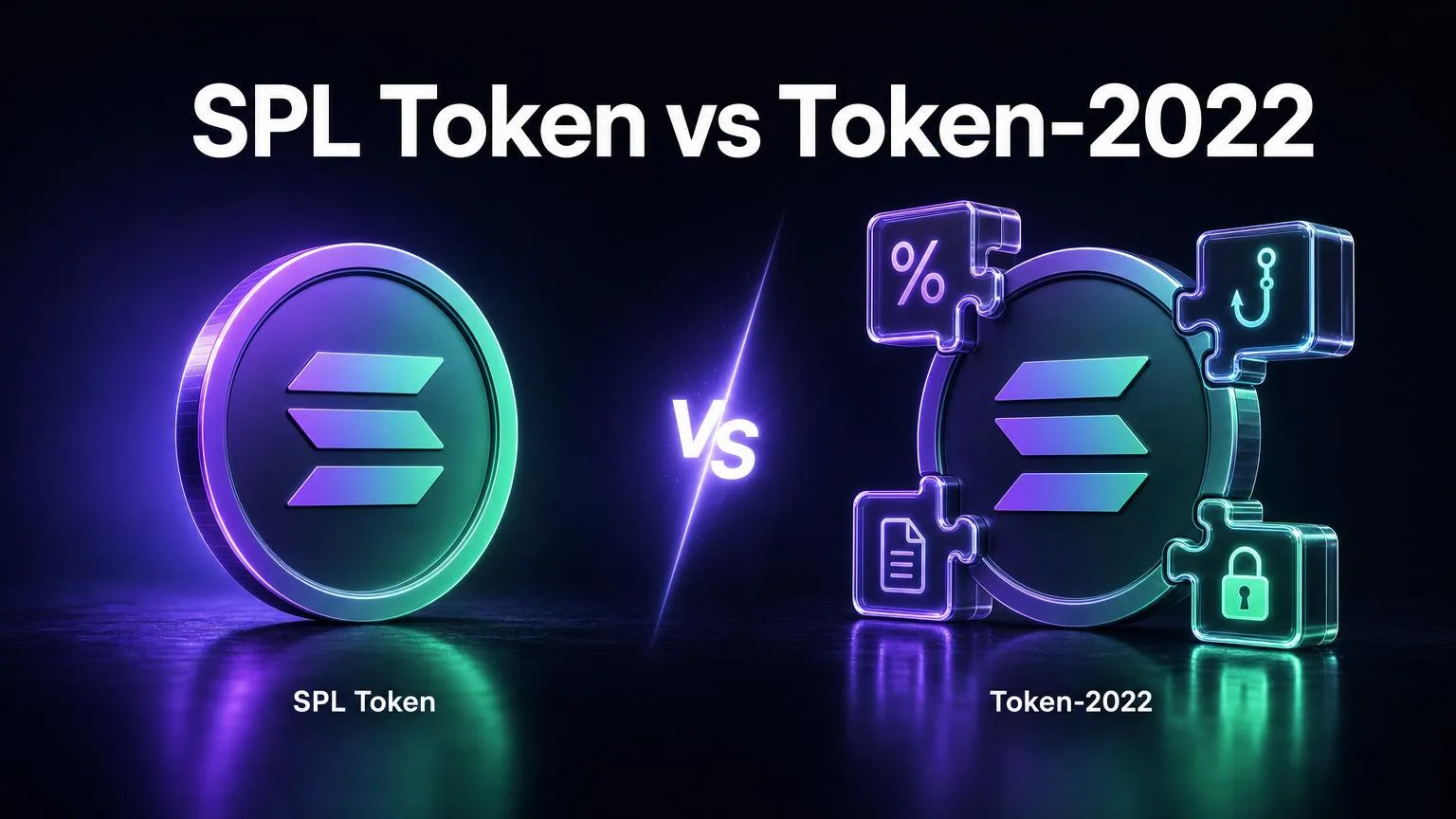
On Solana, tokens are not deployed as separate smart contracts the way they are on Ethereum. They are issued through a shared token program, and there are two of them: the classic SPL Token program and the newer Token-2022, also known as Token Extensions. Both create fungible tokens with balances, decimals and authorities, but they work differently. Your choice decides how much the launch costs, where the name and logo live, which DEXes and services accept the token, and which extra features it can have.
Below we compare them in practice. Every number comes from a real test: on October 20, 2026 we created three test tokens on mainnet with the ChainTx.Tools Token Creator and checked the result on-chain.
The short answer
| SPL Token | Token-2022 (Token Extensions) | |
|---|---|---|
| Program address | TokenkegQfeZyiNwAJbNbGKPFXCWuBvf9Ss623VQ5DA | TokenzQdBNbLqP5VEhdkAS6EPFLC1PHnBqCXEpPxuEb |
| Name, symbol, logo | In a separate Metaplex account | In the mint account itself (Token Metadata extension) |
| Extra features | None | Extensions: transfer fee, transfer hook, permanent delegate and more |
| Creation cost in our test | ≈ 0.0163 SOL | ≈ 0.0049 SOL |
| DEX support | Everywhere, including legacy Raydium AMM v4 pools | Jupiter, Raydium CPMM/CLMM, Meteora, PumpSwap; not Raydium AMM v4 |
| Best for | Maximum compatibility with older infrastructure | New tokens, memecoins, projects that need extensions |
In short: for a new token in 2026, Token-2022 is the sensible default. It is cheaper to create, keeps the metadata inside the mint, and is the standard for Pump.fun launches. SPL Token is still the right pick when you need compatibility with infrastructure that does not understand Token-2022.
What is SPL Token
SPL Token is Solana's original token program, live since the network's early years. Most of the ecosystem's "older" tokens were issued through it: USDC, USDT, first-wave memecoins, liquidity-pool LP tokens.
The program stores only the essentials:
- the mint account: total supply, number of decimals, the mint authority and the freeze authority;
- holders' token accounts: the balance of one wallet in one token.
SPL Token cannot store a name, symbol or logo link. That job is done by a separate program, Metaplex Token Metadata, which creates one more account next to the mint to hold the metadata. Wallets, explorers and DEXes read that account to show the token's name and icon. A separate account means extra rent plus a Metaplex protocol fee, which is why launching an SPL token with metadata costs noticeably more.
What is Token-2022
Token-2022 is a separate token program that keeps everything SPL Token can do and adds extensions. Extensions are enabled when the mint is created (some on token accounts) and are stored right in its data. That makes a Token-2022 mint account longer, and the token more capable.
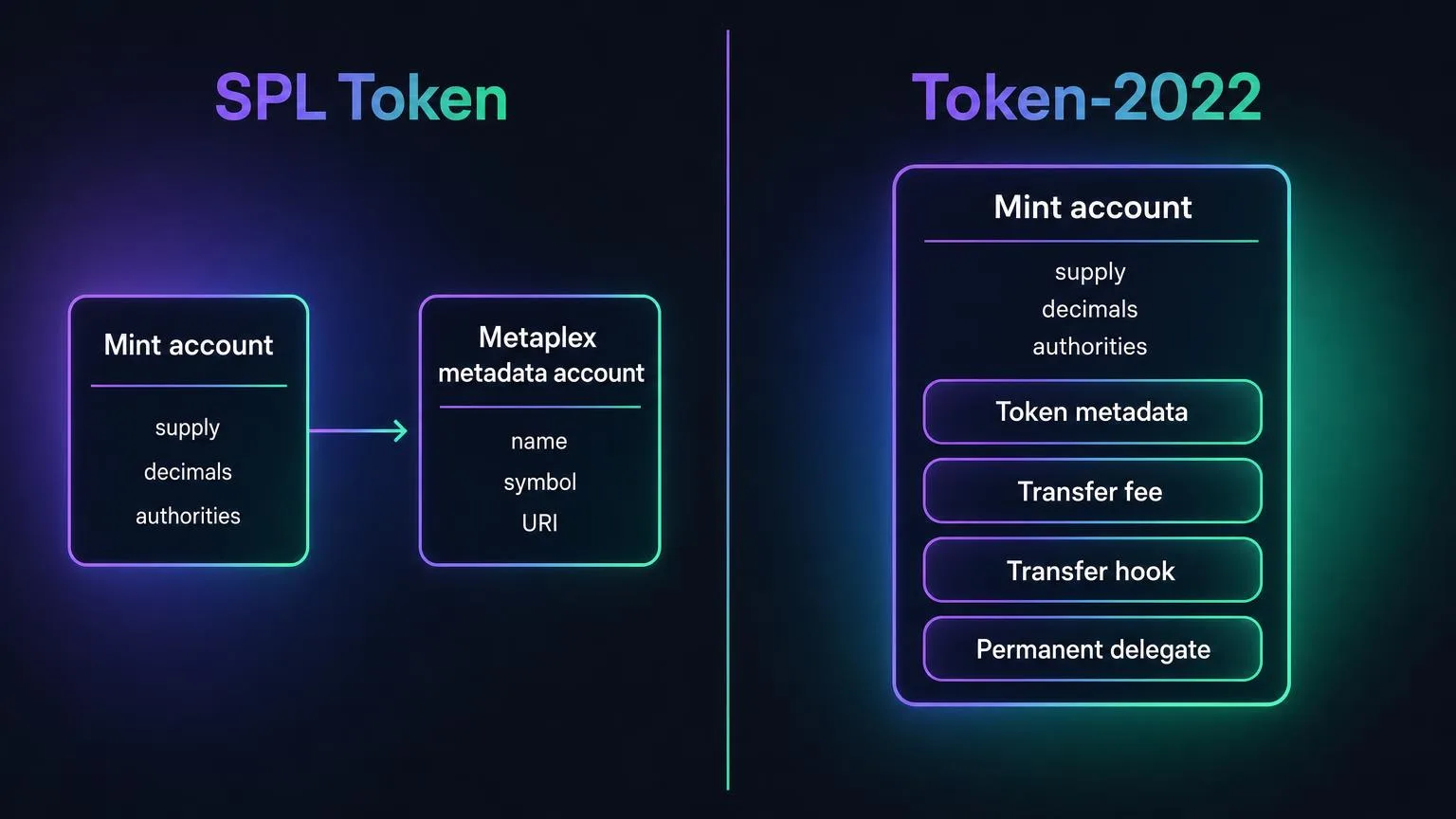
The key point: this is a different program with a different address. A mint belongs either to SPL Token or to Token-2022, and an existing token cannot be "switched" from one program to the other. The address of the associated token account (ATA) also depends on the program, so wallets and services need to know which program a given token uses.
The main Token-2022 extensions
- Token Metadata + Metadata Pointer — the name, symbol and metadata URI are stored in the mint itself, no Metaplex needed. The most popular extension; nearly every new token has it.
- Transfer Fee — a percentage fee (in basis points) on every transfer, with a cap. Withheld tokens accumulate in recipients' accounts and the withdraw authority collects them.
- Transfer Hook — every transfer calls a program you specify. Used for royalties, allowlists and trading restrictions.
- Permanent Delegate — an address that can move or burn tokens from any account. Useful for regulated assets, but a serious risk for holders of an ordinary token.
- Non-Transferable — "soulbound" tokens that cannot be sent (achievements, certificates).
- Interest-Bearing and Scaled UI Amount — the displayed balance grows by a rate or multiplier without new transactions.
- Default Account State — new token accounts start frozen until an administrator thaws them.
- Mint Close Authority — the mint can be closed and its rent reclaimed once the supply is zero.
- Confidential Transfers — transfer amounts hidden with cryptography.
- Pausable — the ability to pause all transfers of the token.
- Token-account extensions: Memo Required (a memo on incoming transfers), CPI Guard, Immutable Owner.
Each extension comes with its own authorities. Many of them show up in token scanners such as RugCheck, and buyers look at them as closely as at the mint and freeze authorities.
In practice: three tokens on mainnet
To keep the comparison grounded, we launched three tokens with identical settings: 6 decimals, a supply of 1,000,000,000, and mint and freeze authorities revoked.
| Token | Program | What's inside | Creation cost |
|---|---|---|---|
| SPLTEST1 | SPL Token | Mint + Metaplex metadata account, one transaction | ≈ 0.0163 SOL |
| TEST2022 | Token-2022 | Metadata Pointer + Token Metadata + 1% Transfer Fee | ≈ 0.0049 SOL |
| PUMPTEST1 | Token-2022 | Pump.fun launch, the whole supply on the bonding curve | ≈ 0.0058 SOL |
The cost includes rent for every account created (mint, the owner's token account, metadata) and network fees, but not the Token Creator's service fee.
What the test shows:
- Token-2022 came out more than three times cheaper. Most of the gap is SPL Token's separate Metaplex account and its creation fee; Token-2022 keeps the metadata in the mint.
- Both fit into one transaction. Creating the mint and metadata, minting the full supply and revoking authorities happen atomically — all or nothing.
- Pump.fun creates Token-2022 tokens. Our PUMPTEST1, launched through Pump.fun's current instruction, turned out to be a Token-2022 mint with its metadata inside.
Compatibility: wallets, DEXes and exchanges
Wallets. Phantom, Solflare, Backpack and other popular wallets display and send Token-2022 tokens, including ones with metadata inside the mint.
DEXes. The Jupiter aggregator, Raydium CPMM and CLMM, Meteora pools (DLMM, DAMM v2, DBC) and PumpSwap all work with Token-2022. The exception is legacy Raydium AMM v4 pools: they only support SPL Token. If you plan to provide liquidity there specifically, that is an argument for SPL.
Extensions and listings. A plain Token-2022 token with nothing but metadata is accepted almost everywhere. Tokens with a transfer fee or a transfer hook, however, are not supported — or are flagged as risky — by some DEXes, aggregators and centralized exchanges. That is why our Token Creator leaves the transfer fee off by default and shows a warning next to the field.
Which one to choose
Choose Token-2022 if:
- you are launching a new token or memecoin and want to pay less for creation;
- you want a "clean" token without Metaplex, with metadata in the mint itself;
- you need extensions: a transfer fee, a transfer hook, non-transferable tokens and so on.
Choose SPL Token if:
- liquidity is planned in Raydium AMM v4 pools or with services that only accept the classic program;
- maximum compatibility with older scripts, bots and integrations matters most.
Either way, for a token buyers are supposed to trust, revoke the mint and freeze authorities, and do not enable a permanent delegate or a high transfer fee without a very good reason.
How to create a token on ChainTx.Tools
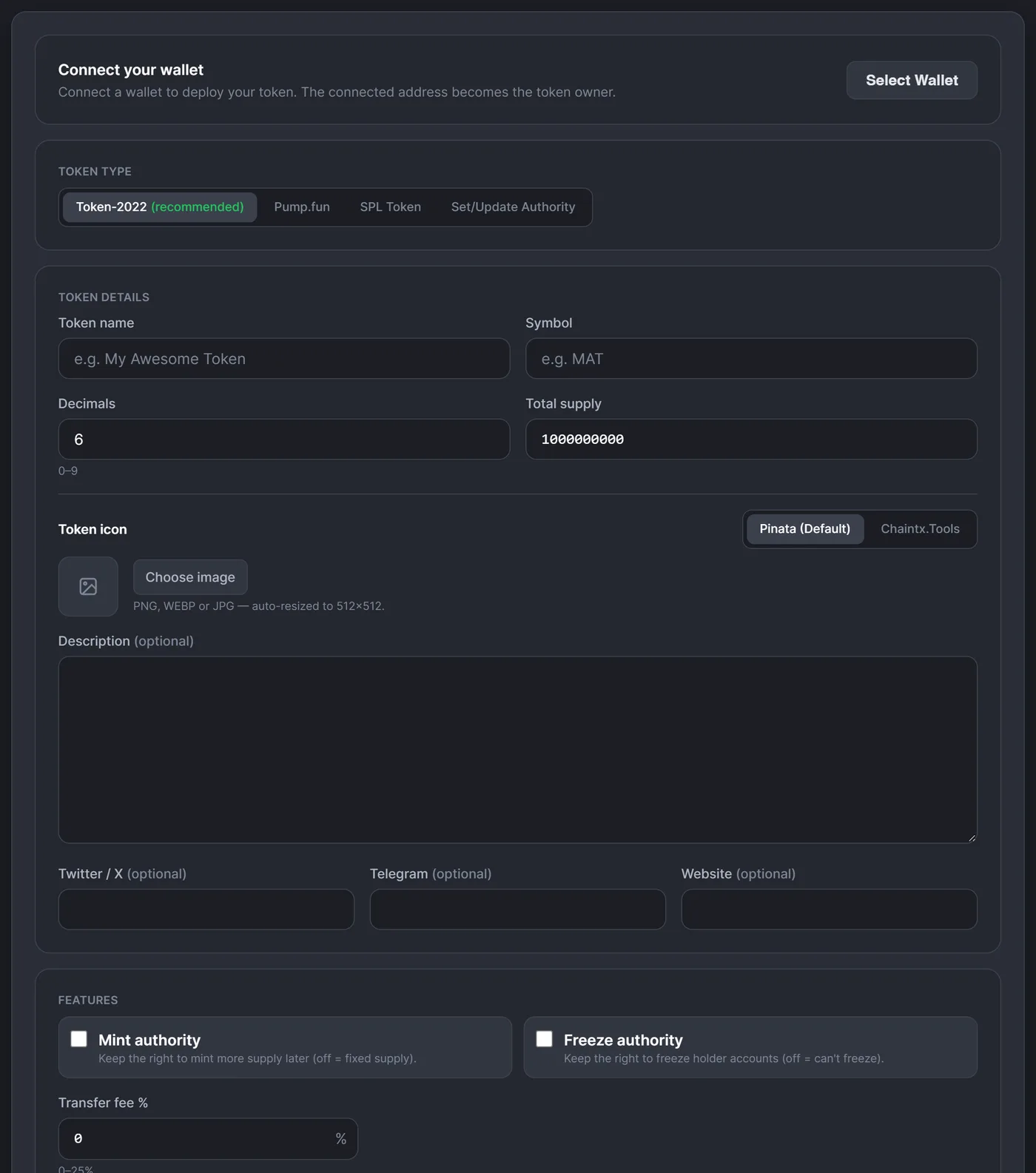
- Open the Solana Token Creator and connect your wallet.
- Pick the type: Token-2022 (recommended), SPL Token or Pump.fun.
- Enter the name, symbol, decimals and supply and upload a logo — the metadata is pinned to IPFS automatically.
- Decide whether to keep the mint and freeze authorities (they are revoked by default) and, for Token-2022, set a transfer fee if you really need one.
- Approve a single transaction in your wallet — the token is created in one step.
You can change or revoke the authorities of an existing token on the Set/Update Authority tab of the same creator.
Summary
SPL Token and Token-2022 do the same job, but Token-2022 is the extensible version, with metadata built in and a set of native features. For most new tokens in 2026 it is cheaper and more convenient, while SPL Token remains the choice for maximum compatibility with older infrastructure. What matters most is knowing which extensions and authorities you enable — that is the first thing buyers and exchanges look at.
FAQ
+Which standard should I choose for a memecoin?
Token-2022: it is cheaper to create, keeps the metadata in the mint itself and is what Pump.fun uses by default. Choose SPL Token if you plan liquidity in legacy Raydium AMM v4 pools.
+Can an existing SPL token be converted to Token-2022?
No. A mint belongs to one program forever. To move to Token-2022, projects create a new token and migrate holders, for example by swapping old tokens for new ones.
+Do wallets support Token-2022?
Yes. Phantom, Solflare, Backpack and other popular wallets display and send Token-2022 tokens, including metadata stored inside the mint.
+Why does an SPL token cost more to create?
An SPL token keeps its metadata in a separate Metaplex account, which costs rent plus a protocol fee. In our test the SPL token cost about 0.0163 SOL to create, the Token-2022 token about 0.0049 SOL.
+Should I enable a transfer fee?
Only if your project really needs one. Some DEXes, aggregators and exchanges do not support tokens with a transfer fee or flag them as risky, and traders tend to avoid them.
+Which is more modern: SPL Token or Token-2022?
Token-2022. It is the newer program (the name reflects the year it was built), and it is where new features land: metadata inside the mint, transfer fees, transfer hooks, confidential transfers and other extensions. SPL Token remains the stable classic standard with no new features — still reliable and supported everywhere, but active development happens in Token-2022.
+Why should you not keep the mint authority?
As long as a token has a mint authority, its owner can mint any number of new tokens at any time and dilute every holder. Scanners such as RugCheck and DexScreener flag these tokens as risky, and many buyers simply skip them. A revoked mint authority guarantees the supply is fixed forever. Keeping it only makes sense when additional issuance is part of the design, for example for a stablecoin or reward tokens.
+Why should you not keep the freeze authority?
The freeze authority lets the owner freeze any holder’s token account, after which that holder can neither sell nor transfer their tokens. This is exactly how many scam (honeypot) tokens work, so RugCheck and other scanners treat an active freeze authority as a serious risk, and some platforms and launchpads require it to be revoked. It is only justified for regulated assets such as USDC, where freezing is a legal requirement.