Why Has Robinhood Chain Become So Popular?
Within weeks of launch Robinhood Chain joined the top three chains by DEX volume and stayed there after the subsidies ended. We explain how Robinhood's Arbitrum-based L2 works, why it grew so fast, what the risks are and how to use it.
 Antonio Vaganovs·Published ·12 min read
Robinhood Chain is the broker Robinhood's own blockchain: an Ethereum Layer 2 built on Arbitrum technology. Its public mainnet opened on July 1, 2026, and within a couple of weeks the network was among the top three chains by DEX trading volume. By autumn, after the launch subsidies had ended, it was still there: by 30-day DEX volume, Robinhood Chain trails only Solana and Ethereum.
Below we look at what the network is, how it works, where the interest comes from and which risks you should know about. The figures come from Robinhood's press releases, the network documentation, L2BEAT and DefiLlama; the technical parameters we measured ourselves through the public RPC.
All figures are as of October 20–21, 2026, unless stated otherwise. On-chain metrics change daily, so important numbers link to their sources.
Short answer: why Robinhood Chain grew so fast
- Audience and brand. The network is backed by a public company: at the end of Q2 2026 Robinhood had 28.4 million funded customers and $369 billion in total platform assets. Robinhood Wallet works with the chain natively.
- Tokenized stocks, 24/7. Stock Tokens give economic exposure to US stocks and ETFs, trade around the clock on-chain and are available through Robinhood Wallet in more than 120 countries.
- A familiar stack. It is a regular EVM chain on Arbitrum: gas in ETH, the same wallets, Solidity and Uniswap. There is nothing new to learn.
- Launch incentives. For the first 90 days Robinhood paid gas for its wallet users, and the Lighter exchange committed LIT tokens to a points program.
- A memecoin wave. Most of the early volume came not from stocks but from memecoins and launchpads — the classic pattern for a new chain.
| Parameter | Value |
|---|---|
| Network type | Ethereum Layer 2 on Arbitrum (Orbit / Nitro stack) |
| Chain ID | 4663 |
| Gas | ETH; there is no separate fee token |
| Block time | ≈ 0.1 s (our measurement over the latest 1M blocks) |
| Data availability | Posted to Ethereum as blobs |
| Public testnet | February 10, 2026 |
| Public mainnet | July 1, 2026 |
| Explorer | robinhoodchain.blockscout.com |
| Public RPC | https://rpc.mainnet.chain.robinhood.com |
What Robinhood Chain is
In its documentation Robinhood describes the network as a permissionless, Ethereum-compatible Layer 2 optimized for tokenized real-world assets (RWAs): equities, ETFs and private assets. Anyone can use the network, deploy contracts and build applications — no permission is required.
Technically it runs on Arbitrum Dedicated Blockchains (formerly Arbitrum Orbit), the same Nitro engine that powers Arbitrum One. Transactions execute on Robinhood Chain, and their data is posted to Ethereum in batches. Key properties:
- gas is paid in ETH — there is no separate token to buy for fees;
- first-come, first-served ordering — transactions are ordered by arrival time at the sequencer, so a higher fee cannot jump ahead of other trades;
- full EVM compatibility — Solidity and Vyper, Hardhat, Foundry, ethers.js, viem and wagmi work unchanged;
- ERC-4337 account abstraction is supported out of the box: gas sponsorship, batching and session keys.
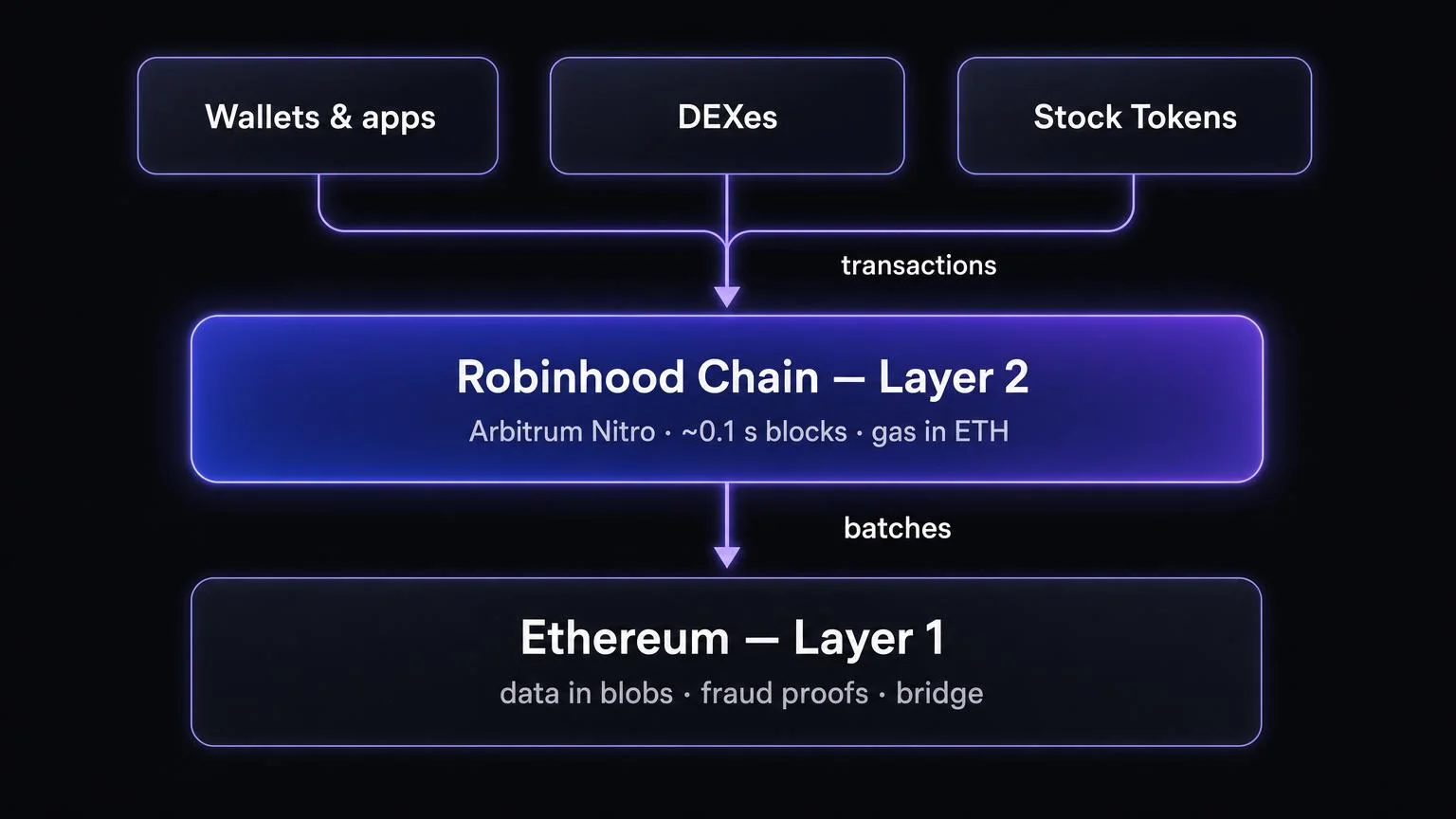
We checked the parameters ourselves through the public RPC. The node reports chain ID 4663 and runs the Nitro v3.12 client. The average block time over the latest million blocks is 0.104 seconds. The base fee is around 0.02 gwei: a plain ETH transfer uses ≈ 21,400 gas and costs about 0.00000044 ETH — roughly a tenth of a cent at an ETH price of $2,461. A curious detail: the first mainnet block is dated April 30, 2026, two months before the network opened to the public.
The road to launch: from Cannes to London
| Date | Event |
|---|---|
| June 30, 2025 | At its Cannes event Robinhood launched stock tokens in the EU (200+ US stocks and ETFs, initially issued on Arbitrum) and announced its own Layer 2 based on Arbitrum |
| February 10, 2026 | Public testnet; Alchemy, Allium, Chainlink, LayerZero and TRM began integrating, and Robinhood committed $1 million to the Arbitrum Open House program |
| July 1, 2026 | At The World is Flat event in London the public mainnet went live, together with the new Stock Tokens and Lighter perpetuals inside Robinhood Wallet |
| August 10, 2026 | Robinhood reported more than $18 billion in DEX volume and over $840 million in TVL since launch |
| Late September 2026 | The 90 days during which Robinhood covered gas for Robinhood Wallet users came to an end |
Day-one partners included Uniswap, which deployed a dedicated AMM as the primary public liquidity protocol, and Pleiades with its proprietary AMM for prop trading. Alchemy, BitGo and Chainlink integrated the chain as well, and lending and borrowing were available from the start.
Five reasons for the popularity
1. Robinhood brings its own audience
The hardest part for any new chain is attracting users. Robinhood solved that in advance: tens of millions of customers and its own Robinhood Wallet, which has the chain, Stock Tokens and Lighter perpetuals built in. Everything needed to get started sits in one app.
That said, a noticeable share of on-chain activity comes not from the broker's customers but from memecoins, bots and launchpads. More on that below.
2. Tokenized stocks that trade 24/7
The core idea of Robinhood Chain is to bring traditional assets on-chain. According to Robinhood and The Block, the new Stock Tokens work like this:
- they are issued by Robinhood Assets (Jersey) Limited as tokenized debt securities;
- they give economic exposure to the price of a stock or ETF but no rights in the underlying securities;
- they trade around the clock on Uniswap, Rialto, Lighter, Arcus and 1inch;
- they can be used in lending pools and as trading collateral;
- they are available through Robinhood Wallet in more than 120 countries, but not in the US or to US persons; restrictions also apply in Canada, the UK, Switzerland, the UAE and sanctioned jurisdictions.
The first generation of tokens, launched in the EU in 2025, is now called Classic Stock Tokens and remains in the Robinhood Europe app.
3. A familiar EVM stack and Arbitrum
Robinhood Chain asks for nothing new: any EVM wallet works, gas is paid in ETH, and smart contracts move over from other chains without a rewrite. Most liquidity sits on well-known DEXes: according to DefiLlama, of the $34.4 billion traded over the last 30 days, about $13.9 billion went through Uniswap V4 and about $12.7 billion through Uniswap V3. Fast 0.1-second blocks and fees measured in fractions of a cent make the chain convenient for active trading.
4. Incentives: free gas and points
At launch Robinhood used proven growth levers. According to The Block, for the first 90 days the company covered gas for Robinhood Wallet users on swaps, crypto and Stock Token transactions, and bridging. Lighter committed 11 million LIT tokens to the Robinhood community, with 2x points for trading through Robinhood Wallet.
In the US, Robinhood Earn launched: lending the USDG stablecoin through a self-custody wallet at an estimated APY of about 7%, powered by the Morpho protocol. USDG is still the largest stablecoin on the chain: about $690 million of $1.07 billion, according to DefiLlama.
5. The memecoin wave
The loudest growth did not come from stocks. As ForkLog reported, by mid-July Robinhood Chain had climbed to third place by DEX volume, and on some days to second. Daily volume peaked at $878 million on July 12. Memecoins drove it: the Noxa launchpad created more than 60,000 tokens, then stopped accepting projects on July 11 and went offline two days later. The CASHCAT memecoin, which has no connection to Robinhood, briefly topped a $200 million market cap. At the same time, tokenized stocks on the chain totaled only about $13 million.
Robinhood Chain by the numbers
| Metric | Value | Source |
|---|---|---|
| DeFi TVL | $1.14B — 8th among all chains, ahead of OP Mainnet, Hyperliquid L1 and Monad | DefiLlama |
| DEX volume, 30 days | $34.4B — 3rd after Solana ($67.8B) and Ethereum ($40.7B), ahead of Base ($29.7B) and BNB Chain ($27.4B) | DefiLlama |
| DEX volume by month | August — $19.0B, September — $53.3B, October 1–20 — $19.3B | DefiLlama |
| Stablecoins on the chain | $1.07B, including USDG ≈ $690M and USDe ≈ $363M | DefiLlama |
| Bridged assets | $2.62B | DefiLlama |
| Total Value Secured | ≈ $2.4B — 4th among L2BEAT projects | L2BEAT |
The key takeaway: activity did not disappear with the subsidies. In the first 20 days of October, with no free gas, $19.3 billion passed through the chain's DEXes — almost $1 billion a day on average.
DefiLlama's TVL counts funds deposited in DeFi protocols. L2BEAT's TVS counts every asset the chain secures, including tokens sitting in wallets. DEX volume includes bot and launchpad trading, so it is best used to compare chains, not as a count of real users.
Robinhood Chain vs Arbitrum One vs Base
| Robinhood Chain | Arbitrum One | Base | |
|---|---|---|---|
| Developed by | Robinhood | Offchain Labs and the Arbitrum DAO | Coinbase |
| Tech stack | Arbitrum Orbit (Nitro) | Arbitrum Nitro | OP Stack |
| Chain ID | 4663 | 42161 | 8453 |
| Gas | ETH | ETH | ETH |
| Block time (our measurement) | ≈ 0.1 s | ≈ 0.27 s | 2 s |
| L2BEAT stage | Below Stage 0 | Stage 1 | Stage 1 |
| TVS (L2BEAT) | ≈ $2.4B | ≈ $10.5B | ≈ $15.6B |
| DeFi TVL (DefiLlama) | $1.14B | $1.44B | $6.24B |
| DEX volume, 30 days | $34.4B | $5.3B | $29.7B |
| Main focus | Tokenized stocks and RWAs | General-purpose DeFi | Consumer apps, the Coinbase ecosystem |
By trading volume Robinhood Chain has already overtaken both networks, and by TVL it is closing in on Arbitrum One. On decentralization it still lags well behind: Arbitrum One and Base are Stage 1, Robinhood Chain is not.
What to keep in mind
Popularity does not remove risk. Before moving large amounts to the chain, consider the following.
- The chain is still highly centralized. According to L2BEAT, Robinhood Chain does not yet meet even the Stage 0 requirements. Only two whitelisted actors can submit fraud proofs, and the challenge period is 6 days 8 hours. Contracts can be upgraded instantly with no exit window, and the sequencer is centralized.
- The operator can block transactions. The chain runs transaction filtering: if a transaction hash is registered in a dedicated precompile, the transaction fails — even when it is force-included from Ethereum.
- Withdrawals to Ethereum through the canonical bridge wait for the challenge period to end, so you cannot quickly move funds back to L1 that way.
- Stock Tokens are not shares. They provide only economic exposure to the price, and availability depends on your country.
- Memecoins are still memecoins. The Noxa story showed how fast liquidity can leave. Before buying, check the contract: can the owner mint more tokens, block addresses or change a tax?
- Robinhood itself stresses in its documentation that the list of ecosystem projects is not an endorsement.
Fees on Robinhood Chain are paid in ETH; the network has no token of its own. Memecoins on the chain are launched by third-party teams: the best-known of them, CASHCAT, has no connection to Robinhood.
How to use Robinhood Chain with ChainTx.Tools
Robinhood Chain is supported in every EVM tool on ChainTx.Tools — just pick it from the network list. Gas is paid in ETH everywhere.
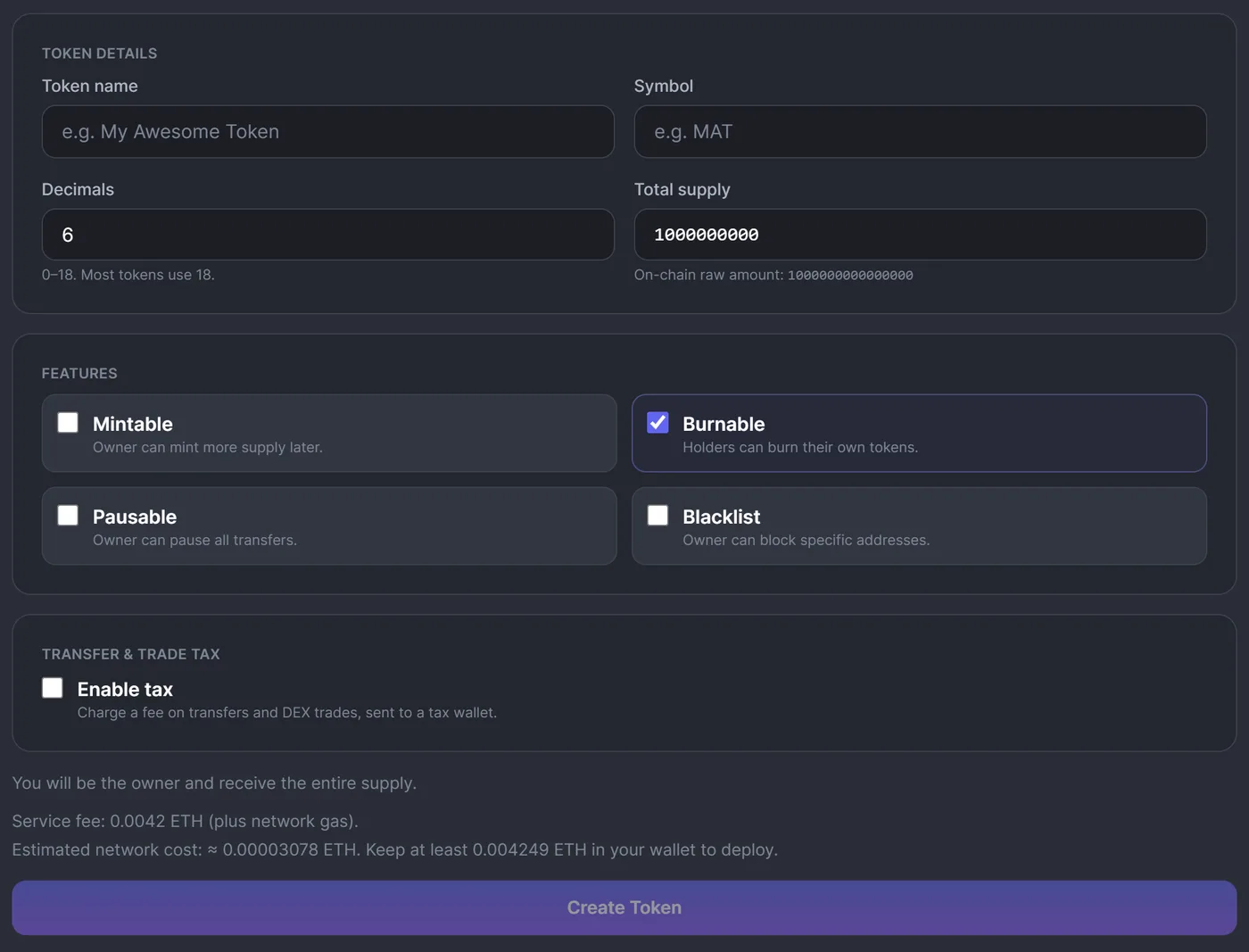
Creating a token. The Robinhood Chain token creator deploys a standard ERC-20 straight from your browser, with no Solidity:
- Open the creator and connect an EVM wallet that holds ETH on Robinhood Chain.
- Enter the name, symbol, decimals and total supply.
- Choose features: Mintable (extra supply), Burnable, Pausable (pause transfers), a Blacklist of addresses and, if needed, a tax on transfers and DEX trades.
- Check the cost: the service fee is 0.0042 ETH plus network gas (when the screenshot was taken, the creator estimated gas at about 0.00003 ETH).
- Confirm the transaction — the connected address becomes the owner and receives the entire supply.
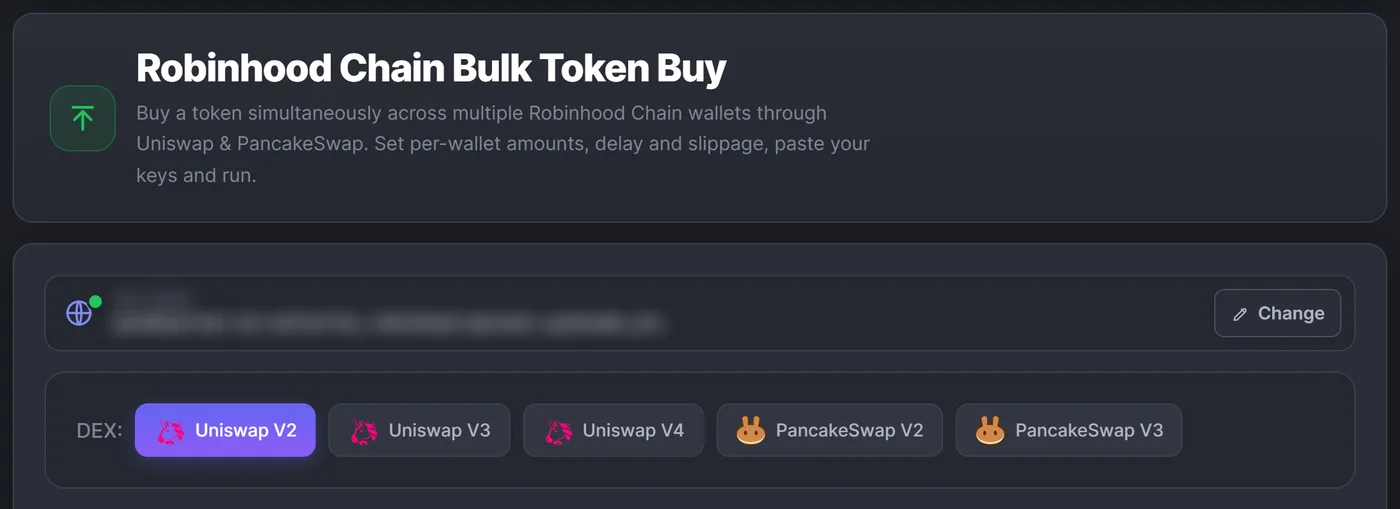
Trading. Bulk buy and bulk sell work across many wallets at once via Uniswap V2, V3, V4 and PancakeSwap V2, V3. The amount can be fixed, random or a percentage of the ETH balance, and you can set a delay and slippage. For a basket of tokens there are multi-token buy and multi-token sell, and to support volume and price there is the EVM market maker.
Transfers and wallets:
- bulk sender — send ETH and ERC-20 tokens to many addresses;
- many-to-one to collect funds from many wallets into one, and many-to-many for batch transfers between wallet pairs;
- transfer all — sweep ETH and every token to one address;
- bulk balance checker — check many wallets at once.
For developers: the Robinhood Chain RPC node checker and the unit converter for ETH ↔ gwei ↔ wei.
Summary
Robinhood Chain became popular thanks to a combination of factors that new chains rarely have. It is a major brand with its own audience and wallet, a clear idea of tokenized stocks trading 24/7, a familiar Arbitrum EVM stack with gas in ETH, and generous launch incentives. The memecoin wave of the first weeks then pushed it to the top of the DEX volume rankings. More importantly, even after the subsidies ended, Robinhood Chain holds third place by DEX volume and sits in the top ten chains by TVL. The flip side is heavy centralization: according to L2BEAT, the chain does not yet reach even Stage 0. For trading and token launches it is already one of the most active EVM chains, but keep the risks of young infrastructure in mind.
FAQ
+What is Robinhood Chain?
Robinhood Chain is an Ethereum Layer 2 developed by the broker Robinhood. It is built on Arbitrum technology, is EVM-compatible and focuses on tokenized real-world assets, primarily stocks and ETFs. The public mainnet launched on July 1, 2026.
+What is the Robinhood Chain chain ID, and what is gas paid in?
The mainnet chain ID is 4663. Gas is paid in ETH; the network has no separate fee token. The public RPC is https://rpc.mainnet.chain.robinhood.com and the block explorer is robinhoodchain.blockscout.com.
+How do I add Robinhood Chain to MetaMask?
In MetaMask choose to add a network manually and enter: network name — Robinhood Chain, RPC — https://rpc.mainnet.chain.robinhood.com, chain ID — 4663, symbol — ETH, explorer — https://robinhoodchain.blockscout.com. You can compare other RPC nodes and their latency in the ChainTx.Tools RPC checker.
+How much does a transaction cost on Robinhood Chain?
In our measurement on October 21, 2026 the base fee was about 0.02 gwei, and a plain ETH transfer cost roughly 0.00000044 ETH — about a tenth of a cent. Swaps and contract calls use more gas and cost more. Free gas for Robinhood Wallet users applied only for the first 90 days after launch.
+Can I buy tokenized stocks on Robinhood Chain?
Stock Tokens are available through Robinhood Wallet in more than 120 countries, but not in the US or to US persons; restrictions also apply in Canada, the UK, Switzerland, the UAE and sanctioned jurisdictions. They are tokenized debt securities issued by Robinhood Assets (Jersey) Limited: they track the stock price but give no rights in the underlying shares.
+Is Robinhood Chain safe?
The chain is still highly centralized. According to L2BEAT, it does not yet meet even the Stage 0 requirements: only two whitelisted actors can submit fraud proofs, contracts can be upgraded instantly, the sequencer is centralized and the operator can filter transactions. Keep this in mind before holding large amounts on the chain.
+Why are there so many memecoins on Robinhood Chain?
A new chain with a big brand, low fees and free gas at launch quickly attracted launchpads and speculators. In July 2026 the Noxa launchpad created more than 60,000 tokens, and the CASHCAT memecoin, which has no connection to Robinhood, briefly topped a $200 million market cap. Most such tokens are very risky.
+How do I create my own token on Robinhood Chain?
The easiest way is the ChainTx.Tools token creator: enter the name, symbol, decimals and supply, choose features (Mintable, Burnable, Pausable, Blacklist, tax) and confirm a single transaction in your wallet. The service fee is 0.0042 ETH plus network gas, and no Solidity code is required.