Which EVM Blockchains Are Still Popular in 2026?
A 2026 ranking of EVM chains built on verifiable DefiLlama, L2BEAT and growthepie data: TVL, DEX volume, stablecoins and active addresses. Why Ethereum, BNB Chain, Base and Robinhood Chain are popular, which hyped launches lost 95–99% of TVL, and how to pick a chain.
 Antonio Vaganovs·Published ·15 min read
The EVM — the Ethereum Virtual Machine — is still the dominant smart-contract standard. The same wallet with a 0x… address and the same contracts work across dozens of networks: Ethereum itself, its L2s and standalone L1s such as BNB Chain or Monad. But the picture has changed a lot over the past year: some networks grew, while others that were loud not long ago lost up to 99% of their funds.
Below is a ranking of the EVM chains that are actually popular in 2026. Every number comes from a public dashboard, with its source and date. For each network we explain what drives its popularity and who it suits.
Unless stated otherwise, DeFi TVL, DEX volume, stablecoins and active addresses are DefiLlama data at the time of writing (October 2026); DEX volume is the total for the last 30 days. TVS and L2 stages are from L2BEAT. Median fees and transaction counts are from growthepie, averaged over the last 30 days.
Short answer: the most popular EVM chains in 2026
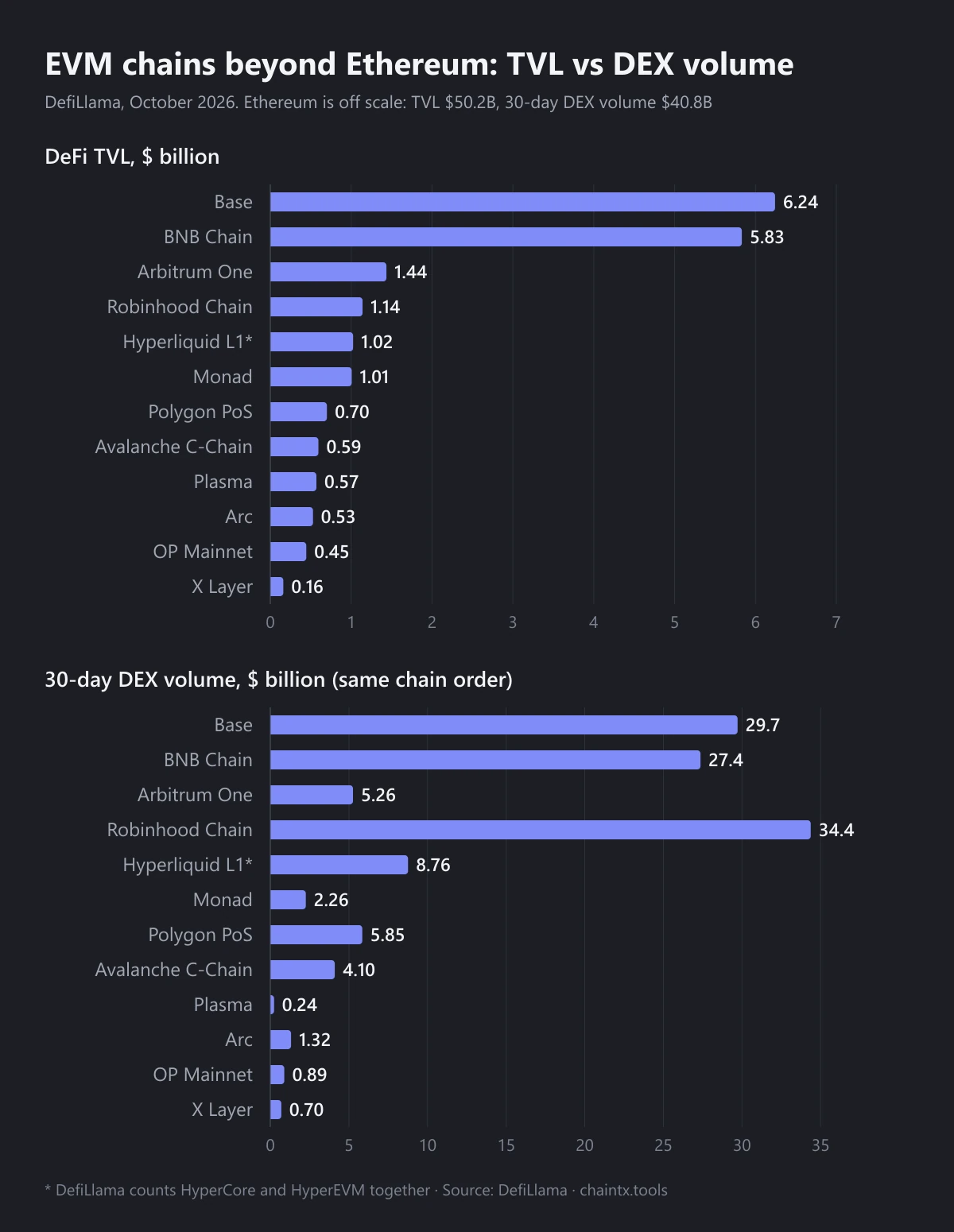
Networks are sorted by DeFi TVL — the value locked in DeFi protocols. The other columns show how much the ranking shifts depending on the metric.
| # | Network | DeFi TVL | 30-day DEX volume | Stablecoins | Daily active addresses |
|---|---|---|---|---|---|
| 1 | Ethereum | $50.2B | $40.8B | $143.7B | 464K |
| 2 | Base | $6.24B | $29.7B | $5.13B | 373K |
| 3 | BNB Chain | $5.83B | $27.4B | $13.1B | 2.4M |
| 4 | Arbitrum One | $1.44B | $5.26B | $3.52B | 152K |
| 5 | Robinhood Chain | $1.14B | $34.4B | $1.07B | 255K¹ |
| 6 | Hyperliquid L1 (HyperEVM)² | $1.02B | $8.76B | $7.04B | 17.7K |
| 7 | Monad | $1.01B | $2.26B | $686M | 8.7K |
| 8 | Polygon PoS | $700M | $5.85B | $2.83B | 497K |
| 9 | Avalanche C-Chain | $595M | $4.10B | $1.25B | 41.6K |
| 10 | Plasma | $570M | $240M | $1.27B | 26.3K |
| 11 | Arc | $528M | $1.32B | $751M | 22.4K |
| 12 | OP Mainnet | $445M | $890M | $584M | 13.2K¹ |
| 13 | X Layer | $161M | $700M | $1.5B | 33.4K |
¹ growthepie data for the last full day: DefiLlama does not show active addresses for this network.
² DefiLlama counts Hyperliquid L1 as a whole — the HyperCore order book and the HyperEVM layer together.
Key takeaways:
- Ethereum is still the center of the EVM world. It holds about 56% of all DeFi TVL across every blockchain ($50.2B of $90.1B), and together with the other EVM chains almost 80% (our calculation from DefiLlama data).
- BNB Chain leads by users: 2.4M daily active addresses, roughly five times more than Ethereum or Polygon PoS.
- Base is the leading L2. By TVL it is the second-largest blockchain in the world, ahead of Solana ($5.98B) and Tron ($5.55B), and the only large network whose TVL grew over the year.
- Robinhood Chain is the newcomer of the year. It launched on July 1, 2026 and already beats Base and BNB Chain on 30-day DEX volume.
- Many hyped 2025 launches lost 95–99% of their TVL — Berachain, Linea, Sonic, Unichain and others (details below).
What makes a network "popular"
There is no single number for blockchain popularity. Different metrics answer different questions:
- DeFi TVL — how much money sits in a network's DeFi protocols: liquidity pools, lending, staking. It shows capital's trust. But TVL is measured in dollars and falls together with token prices, even if nobody withdraws anything.
- TVS (Total Value Secured) on L2BEAT — all assets on an L2, including tokens held in ordinary wallets, not only in DeFi. That is why TVS is usually much larger than TVL: Arbitrum One has $10.45B of TVS versus $1.44B of DeFi TVL.
- Stablecoins — how many dollar tokens circulate on the network. A good indicator of payments and real economic activity.
- DEX volume — how much is traded on decentralized exchanges. It reflects trader demand, memecoins included, but is easily inflated by bots and wash trading.
- Active addresses and transactions — the closest thing to "number of users", but one person can run hundreds of addresses and bots generate millions of transactions. For example, MegaETH averages 1.16M transactions a day with only 1.9K active addresses (growthepie).
That is why the ranking shows several metrics at once: a network is truly popular when it is strong in at least two or three of them.
Ethereum: still the center of the EVM
Ethereum is the base layer of the whole EVM ecosystem. Its DeFi holds $50.2B, and $143.7B of stablecoins and $13.7B of tokenized real-world assets (RWA) circulate on it. Its 30-day DEX volume is $40.8B — second among all blockchains after Solana ($67.8B).
Over the year Ethereum's TVL fell 41%, from $84.8B a year earlier. Much of this is a price effect: at the time of writing DefiLlama shows ETH at $2,452. Ethereum's share of DeFi remains overwhelming.
Why Ethereum is popular:
- Capital and institutions. The largest protocols — Lido, Aave, Sky, Ethena — and most stablecoins and tokenized funds live here.
- Security. It is the most battle-tested EVM network, and rollups publish their data to it.
- Liquidity. Large trades are cheaper where pools are deepest.
The main drawback is transaction cost: the median fee is about $0.075 (growthepie), 15–50 times more than on Arbitrum or Base. That is why retail users and memecoins moved to L2s and alternative chains long ago.
BNB Chain: the most users
BNB Chain is the most mass-market EVM network: 2.4M daily active addresses. By TVL ($5.83B) it ranks third among all blockchains, and by stablecoins ($13.1B) second among EVM chains after Ethereum. Its 30-day DEX volume is $27.4B, although that is 27% less than in the previous 30 days.
Why BNB Chain is popular:
- Memecoins and launchpads. The Flap.sh launchpad earned the most fees on the network over 30 days — $33.3M; the GMGN trading bot and the Predict Fun prediction market are also among the leaders (DefiLlama).
- PancakeSwap is the backbone of DEX liquidity: PancakeSwap V3 alone did $12.6B of volume in 30 days.
- Cheap transactions and the Binance connection — easy deposits and withdrawals through the largest exchange.
Base: the leading L2 and rare growth
Base is Coinbase's L2 built on the OP Stack. It is the only large EVM network whose DeFi TVL grew over the year — by about 26% (from $4.97B a year earlier) — and on October 5, 2026 it set an all-time high of $6.47B.
- Security: on L2BEAT, Base has the largest TVS among rollups — $15.56B — and is Stage 1.
- Activity: 373K daily active addresses; 100.6 user operations per second (UOPS) on L2BEAT — almost five times more than Ethereum itself (20.8).
- Cost: a median fee of about $0.0016 (growthepie).
Why Base is popular: a direct path from Coinbase and its wallet, deep DEXs (Aerodrome Slipstream did $15.4B of volume in 30 days, Uniswap V3 $6.1B), the Morpho lending protocol and plenty of memecoins. For many new users Base is the first network after the exchange.
Arbitrum One and OP Mainnet: the L2 veterans
Arbitrum One is still the second rollup by TVS on L2BEAT — $10.45B, Stage 1. But its DeFi TVL shrank sharply: $1.44B versus $3.93B a year ago (−63%). The network has 152K daily active addresses, $5.26B of 30-day DEX volume and strong positions in derivatives and RWA: USD AI, Spiko, GMX and Uniswap are among the fee leaders. The median fee is about $0.0045.
OP Mainnet on its own is small: $445M of TVL (up 30% over the year, though) and about 13K daily active addresses. Its real strength is the OP Stack: Base, Ink (Kraken's L2), Unichain, World Chain, Celo, X Layer and MegaETH all run on it. Among the large EVM rollups, L2BEAT rates Base, Arbitrum One, OP Mainnet, Ink and Unichain as Stage 1.
New networks that actually gained weight
Robinhood Chain
Robinhood's L2 built on the Arbitrum codebase, with gas paid in ETH. The network launched on July 1, 2026 and was designed for tokenized stocks, but the first wave of demand came from memecoins (The Block). Less than four months after launch, the results are:
- DeFi TVL of $1.14B — an all-time high at the time of writing;
- 30-day DEX volume of $34.4B — third among all blockchains after Solana and Ethereum; $53.3B in September 2026 alone;
- 70.3 UOPS on L2BEAT — more than Ethereum, Arbitrum One and OP Mainnet combined.
Most fees go to Uniswap V4 ($45.9M in 30 days) and the chain's own Pons launchpad ($33.2M). We explain why the network grew so fast in “Why Has Robinhood Chain Become So Popular?”.
HyperEVM (Hyperliquid)
HyperEVM is the EVM layer of the Hyperliquid blockchain, running next to the HyperCore order book; gas is paid in HYPE. DefiLlama counts them together: $1.02B of TVL (−52% over the year), $7.04B of stablecoins and $7.5B of perpetuals volume per day. Most of the money and fees come from HyperCore perps — $82M in fees over 30 days. The EVM side is more modest: 17.7K daily active addresses and spot DEXs such as Project X ($1.51B in 30 days). How to name this network correctly and how HyperEVM differs from HyperCore is covered in “HyperEVM or Hyperliquid Blockchain: Which Name Is Correct?”.
Monad
Monad is an L1 with parallel execution of EVM transactions; its mainnet and the MON token launched on November 24, 2025 (The Block). Since the start of 2026 its TVL has quadrupled, from $246M to $1.01B, and RWA on the network reached $415M. Retail activity is modest, though: 8.7K daily active addresses, and its 30-day DEX volume ($2.26B) is half of the previous 30 days. The top protocols by fees are lenders (Accountable, Aave, Morpho, Euler): right now Monad appeals more to capital than to traders.
Stablecoin chains: Arc, Plasma and Tempo
A new class of EVM blockchains is built for stablecoin payments, where fees are not paid in a volatile token.
- Arc is Circle's L1 with gas paid in USDC; its public mainnet opened on September 16, 2026 (Cointelegraph). TVL is $528M, stablecoins $751M (+41% in a week), and 30-day DEX volume $1.32B — 3.2 times the previous 30 days.
- Plasma is a stablecoin network launched in September 2025. Its TVL is now $570M, but that is −91% from the $6.36B peak on October 9, 2025: capital that came for rewards has left. The network holds $1.27B of stablecoins and has 26.3K daily active addresses.
- Tempo is a payments L1 from Stripe and Paradigm, live on mainnet since March 18, 2026 (Bankless), with fees paid in stablecoins. Its TVL is only $107M so far, but it already has $724M of stablecoins.
X Layer
OKX's L2 with gas paid in OKB. Its TVL grew 6.7 times over the year, from $24M to $161M; the network holds $1.5B of stablecoins and has 33.4K daily active addresses. Like Base with Coinbase, X Layer builds on its exchange's audience.
Polygon PoS, Avalanche and Celo: popularity beyond DeFi
Polygon PoS lost DeFi TVL ($700M, −43% over the year), but it remains one of the most used EVM networks: 497K daily active addresses and about 4.9M transactions a day (growthepie). Its top app is the Polymarket prediction market — $30.3M of fees in 30 days, the most on the network. Stablecoins total $2.83B, and the median fee is about $0.01.
Avalanche C-Chain: $595M of TVL (−69% over the year), but its 30-day DEX volume grew 28% to $4.10B (Pharaoh, Uniswap, Blackhole, LFJ). The network's strength is tokenized assets: $1.12B of RWA, with the BlackRock BUIDL fund and Centrifuge among the fee leaders.
Celo shows popularity without TVL: just $13.6M in DeFi, but an average of 454K active addresses and 916K transactions a day (growthepie). According to Opera and Celo, most of the activity comes from stablecoin payments through the MiniPay wallet.
Who lost popularity
High launch TVL often rests on rewards: points, airdrop farming, liquidity programs. When the rewards end, the capital leaves. Here are networks that were among the most talked about in 2025 (DeFi TVL per DefiLlama):
| Network | Peak DeFi TVL | Peak date | Current TVL | From peak |
|---|---|---|---|---|
| Berachain | $3.31B | Mar 27, 2025 | $32.0M | −99% |
| Linea | $1.68B | Sep 21, 2025 | $24.1M | −99% |
| Sonic | $1.14B | May 11, 2025 | $19.5M | −98% |
| Unichain | $903M | Jul 21, 2025 | $26.5M | −97% |
| Katana | $711M | Mar 7, 2026 | $37.6M | −95% |
| Sei | $628M | Jul 18, 2025 | $32.4M | −95% |
| MegaETH | $246M | May 12, 2026 | $12.4M | −95% |
This does not mean these networks are "dead". Linea still has $355M of TVS on L2BEAT — the assets simply sit in wallets rather than in DeFi. Unichain and MegaETH process hundreds of thousands to millions of transactions a day, but mostly from bots: Unichain has about 2.7K active addresses for 699K daily transactions (growthepie). For launching a project, such networks are riskier than the leaders of the ranking.
How to choose an EVM chain for your task
| Task | Where to look | Why |
|---|---|---|
| Large amounts, RWA, institutional liquidity | Ethereum | $143.7B of stablecoins, $13.7B of RWA, the deepest pools |
| A memecoin and a retail audience | BNB Chain, Base, Robinhood Chain | The most active traders, launchpads and DEX volume |
| Cheap DeFi | Base, Arbitrum One | Median fee of $0.0016–0.0045, mature DEXs and lending |
| Perpetuals and active trading | Hyperliquid, Arbitrum One | The largest perps volumes among EVM chains: $7.5B and $3.6B a day |
| Stablecoin payments | Polygon PoS, Celo, Arc, Plasma | Mass transfers; on Arc gas is paid directly in USDC |
| Betting on a new ecosystem | Robinhood Chain, Monad, Arc | Fast growth and attention, but higher risk |
Before launching a project, check:
- Where the traders already are for your use case — look at DEX volume and active addresses, not just TVL.
- The trend, not a snapshot: compare metrics over 3–6 months so you don't land on a network right after its rewards end.
- Transaction costs for your users.
- Support from wallets, bridges, aggregators and exchanges.
- Decentralization: for an L2, its stage on L2BEAT (Stage 0, 1 or 2).
- The gas token: ETH on Base, Arbitrum, OP Mainnet and Robinhood Chain; BNB, POL, AVAX, HYPE and MON on their own networks; USDC on Arc, XPL on Plasma, OKB on X Layer.
ChainTx.Tools for these networks
ChainTx.Tools supports 29 EVM networks, including every network in the ranking. Without writing code you can create a token, run a bulk send, buy or sell a token from many wallets at once and check the balances of a list of addresses:
| Network | Create a token | Multisender | Bulk buy / sell | Balances |
|---|---|---|---|---|
| Ethereum | Create | Send | Buy · Sell | Check |
| BNB Chain | Create | Send | Buy · Sell | Check |
| Base | Create | Send | Buy · Sell | Check |
| Arbitrum One | Create | Send | Buy · Sell | Check |
| Robinhood Chain | Create | Send | Buy · Sell | Check |
| HyperEVM | Create | Send | Buy · Sell | Check |
| Monad | Create | Send | Buy · Sell | Check |
| Polygon PoS | Create | Send | Buy · Sell | Check |
| Avalanche C-Chain | Create | Send | Buy · Sell | Check |
| OP Mainnet | Create | Send | Buy · Sell | Check |
| Plasma | Create | Send | Buy · Sell | Check |
| Arc | Create | Send | Buy · Sell | Check |
| X Layer | Create | Send | Buy · Sell | Check |
| Celo | Create | Send | Buy · Sell | Check |
All EVM networks also work with the market maker for automated buy/sell strategies and with Transfer All, which moves every coin and token from many wallets to one address.
If you haven't picked a network yet, start where your audience already is. A token on Base or BNB Chain will be seen by more traders than one on a network with a few thousand daily active addresses — even if gas is cheaper there.
Summary
In 2026 the EVM world rests on a few pillars. Ethereum is the money: more than half of all DeFi TVL and $143.7B of stablecoins. BNB Chain is the users: 2.4M daily active addresses. Base is the leading L2 and almost the only large network that grew over the year. Among newcomers, real weight was gained by Robinhood Chain (third in the world by 30-day DEX volume), Monad (TVL ×4 since the start of the year) and the stablecoin chains Arc and Plasma, while Arbitrum, Polygon PoS and Avalanche keep their niches in DeFi, payments and RWA.
The main lesson of the year: a loud launch and high early TVL guarantee nothing. Berachain, Linea, Sonic and Unichain lost 97–99% of their TVL from the peak. When choosing a network, look at several metrics and their trends at once — and check fresh data: these numbers are current as of October 2026.
FAQ
+Which EVM chain is the most popular in 2026?
It depends on the metric. By money it is Ethereum: $50.2B of DeFi TVL and $143.7B of stablecoins. By users it is BNB Chain: 2.4M daily active addresses. By 30-day DEX volume among EVM chains, Ethereum leads ($40.8B), followed by Robinhood Chain ($34.4B) and Base ($29.7B). DefiLlama data, October 2026.
+Which popular EVM chain has the cheapest transactions?
According to growthepie (average over the last 30 days), the median fee is about $0.00004 on OP Mainnet, $0.0016 on Base, $0.0045 on Arbitrum One and about $0.01 on Polygon PoS. On Ethereum itself it is about $0.075 — 15–50 times more than on Arbitrum or Base.
+Base or Arbitrum — which should I choose?
Base is currently larger on almost every metric: $6.24B of DeFi TVL versus $1.44B, 373K daily active addresses versus 152K, and $29.7B of 30-day DEX volume versus $5.26B. Base suits memecoins and a retail audience better. Arbitrum One remains strong in derivatives and RWA and has the second-largest TVS among rollups ($10.45B on L2BEAT). Both are Stage 1.
+Why did almost every network's TVL fall over the year?
TVL is measured in dollars, so it falls together with token prices: at the time of writing DefiLlama shows ETH at $2,452. On top of that, capital leaves networks when reward programs end. Against this backdrop Base (+26% over the year), OP Mainnet (+30%) and X Layer (6.7×) grew, while Robinhood Chain and Arc launched in 2026 and each quickly passed $500M of TVL.
+Should I launch a token on a new chain like Robinhood Chain or Monad?
New networks bring attention and less competition, but their liquidity is less stable: Monad's 30-day DEX volume roughly halved, and Robinhood Chain's fell 32% versus the previous 30 days (DefiLlama). If you need the largest audience, BNB Chain or Base is the safer bet; if you are betting on early growth, a new network can work, but be ready for volatility. You can launch a token on any of these networks without code using the ChainTx.Tools token creator.
+What do Stage 0, Stage 1 and Stage 2 mean on L2BEAT?
They describe how decentralized a rollup is. Stage 0 means full training wheels: not only the security council can block withdrawals. Stage 1 means users can withdraw even if the operator is malicious, and only the security council can intervene. Stage 2 means the security council may act only on provable bugs in the code, and users get at least 30 days to exit before regular upgrades. Among the large EVM rollups, Base, Arbitrum One, OP Mainnet, Ink and Unichain are Stage 1 (L2BEAT, October 2026).
+Do I need a separate wallet for each EVM chain?
No. A 0x… address is the same on every EVM network, and one wallet (MetaMask, Rabby and others) works with all of them — you just add the network. But each network needs its own gas token for fees: ETH on Base, Arbitrum, OP Mainnet and Robinhood Chain, BNB on BNB Chain, POL on Polygon, AVAX on Avalanche, HYPE on HyperEVM, MON on Monad, USDC on Arc, XPL on Plasma and OKB on X Layer. Tokens on different networks are different contracts: USDC on Base and USDC on Arbitrum are not interchangeable without a bridge.