What Are EVM Blockchain Layers L0, L1, L2 and L3 and How Do They Work
L0, L1, L2 and L3 explained in plain language: what each layer does, how rollups post data to Ethereum, why L2 fees are so low, which L3s survived — and where 29 EVM networks supported by ChainTx.Tools fit, with L2BEAT data for October 2026.
 Antonio Vaganovs·Published ·13 min read
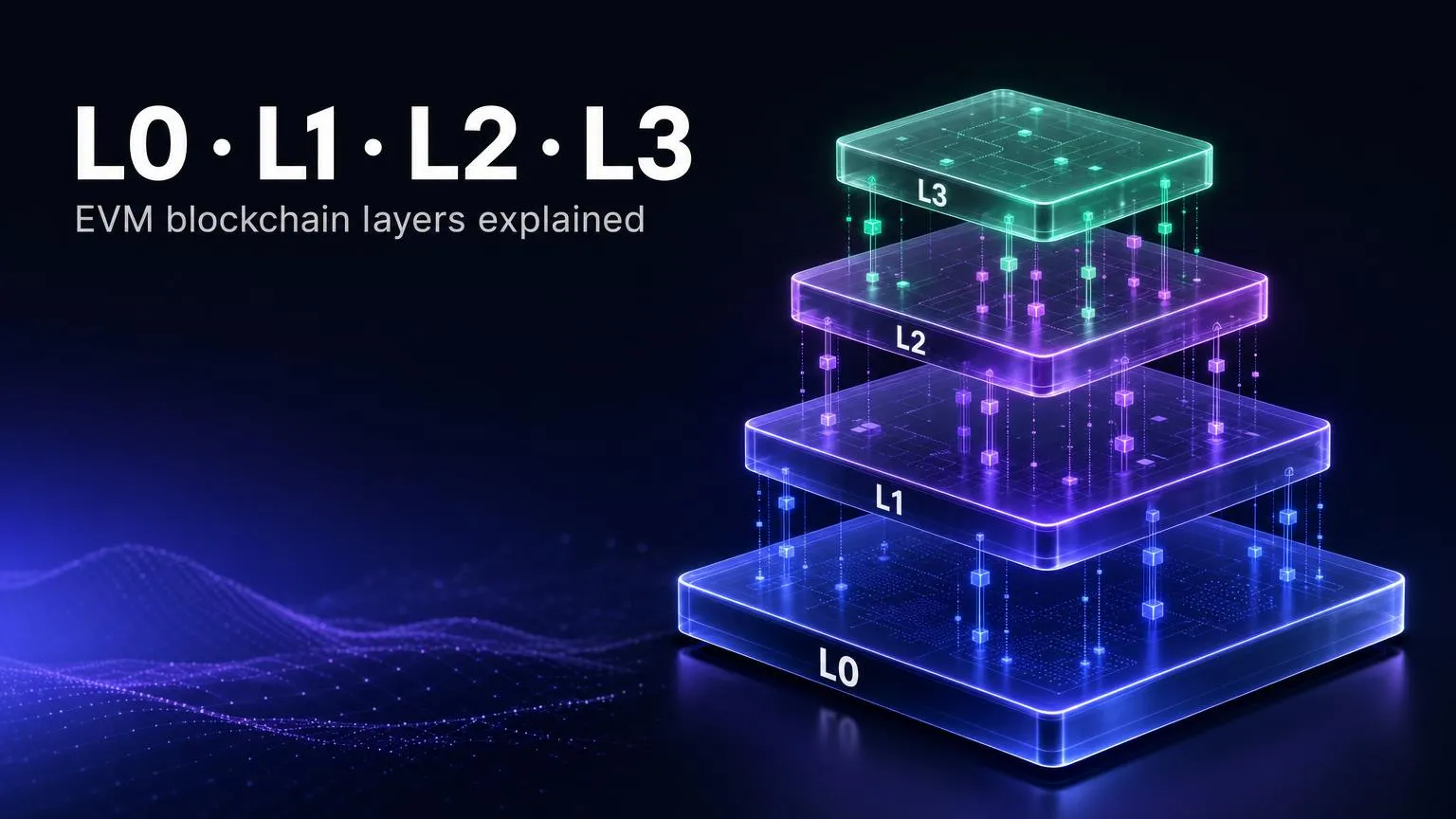
"L2", "rollup", "L3", "a Layer 0 protocol" — these labels are everywhere in crypto, and they are used loosely. In fact there is no protocol standard that defines layers L0–L3: they are an informal way to describe who does which job in a blockchain stack. L1 and L2 have fairly precise meanings in the Ethereum ecosystem, "L0" means two different things depending on who says it, and L3 is simply "an L2 on top of an L2".
This guide explains each layer in plain language, shows how a transaction actually travels from an L2 to Ethereum, and puts current numbers (October 2026) next to the theory — including where the EVM networks supported by ChainTx.Tools fit.
The short answer
| Layer | What it is | EVM examples | Where security comes from |
|---|---|---|---|
| L0 | Either a base network that gives shared security to chains on top of it, or a cross-chain messaging protocol | Polkadot relay chain, Cosmos IBC; LayerZero, Wormhole, Chainlink CCIP | Its own validators or verifier networks |
| L1 | An independent blockchain that does everything itself | Ethereum, BNB Chain, Avalanche C-Chain, Monad, Sonic, Berachain | Its own validators and consensus |
| L2 | A chain that executes transactions off Ethereum and posts data and proofs back to it | Arbitrum One, Base, OP Mainnet, ZKsync Era, Linea | Ethereum (to the degree its proof system and upgrade keys allow) |
| L3 | A chain that settles to an L2 instead of to Ethereum | ApeChain, Xai, EDU Chain (Arbitrum One) | Its L2, and through it Ethereum |
Why blockchains have layers at all
Every blockchain has to do four jobs:
- execution — run transactions and update balances;
- consensus — agree on the order of transactions;
- data availability (DA) — make the transaction data public so anyone can check it;
- settlement — be the final judge of which state is correct.
An L1 does all four itself. Doing everything on one chain is secure but limited in throughput, so the Ethereum ecosystem moved execution to layer-2 networks while keeping data availability and settlement on Ethereum. That is the whole idea behind "layers".
| Job | L1 (Ethereum) | Rollup (L2) | Sidechain | Validium / Optimium |
|---|---|---|---|---|
| Execution | itself | itself | itself | itself |
| Ordering | itself | sequencer (often one operator) | own validators | sequencer |
| Data availability | itself | Ethereum (blobs or calldata) | itself | off-chain (committee, EigenDA, Celestia…) |
| Settlement | itself | Ethereum checks a proof | not on Ethereum — the bridge trusts validators | Ethereum checks the proof, but data can be withheld |
L0: one label, two meanings
Meaning 1: a base network for other chains. The Polkadot docs literally call Polkadot "a Layer-0 protocol": its relay chain gives shared security to the application-specific chains connected to it. Cosmos IBC, a protocol that lets independent blockchains talk to each other through light clients, is usually put in the same bucket. The Avalanche Primary Network is often called an "L0" too, but Avalanche's own documentation calls it "a special Avalanche L1".
Meaning 2: cross-chain messaging. LayerZero, Wormhole and Chainlink CCIP move messages and tokens between chains. They are not blockchains at all: they are smart contracts deployed on existing L1s and L2s plus off-chain verifiers — app-selected verifier networks (DVNs) in LayerZero, 19 Guardians signing 13-of-19 attestations in Wormhole, and a network of 16 independent node operators in CCIP.
The product name "LayerZero" sounds like a layer below L1, but technically it sits on top of existing chains. Ethereum has no "L0" underneath it. Treat "L0" as an architecture or marketing label, not as a protocol layer.
L1: the base layer
An L1 is an independent blockchain with its own validators and consensus, and it does execution, ordering, data availability and settlement itself. Ethereum, BNB Smart Chain, the Avalanche C-Chain, Monad (public mainnet since November 24, 2025), Sonic, Berachain, Flare and Kaia are all EVM-compatible L1s.
For Ethereum, being an L1 also means being the settlement and data layer for hundreds of other chains. After the Fusaka upgrade the default block gas limit is 60 million, and in mid-October 2026 the base fee was around 0.07 gwei — so even the base layer is cheap by historical standards.
L2: rollups and their relatives
An L2 executes transactions on its own chain, compresses them into batches and posts the batches to Ethereum together with a way to verify them. Fixed L1 costs are split across everyone in the batch, which is why L2 transactions are cheaper.
Optimistic rollups
They assume every batch is correct and rely on fraud proofs: anyone can challenge an invalid state during a challenge window. Withdrawals to Ethereum have to wait out that window:
| Network | Proof system | Withdrawal to Ethereum |
|---|---|---|
| Arbitrum One | Permissionless interactive fraud proofs (BoLD) | about 6 days 8 hours |
| OP Mainnet | Interactive fraud proofs | 3.5 days challenge + 3.5 days delay |
| Base | Multiproof since late May 2026 (TEE attestation + ZK proof) | about 1 day if both proofs agree, otherwise 5 days |
Data from L2BEAT project pages, October 2026. Third-party bridges are often much faster, but then you trust the bridge's liquidity provider.
ZK rollups
They post a validity proof (a SNARK or STARK) with every state update. Ethereum verifies the proof, so there is no challenge window: a withdrawal can be executed as soon as the proof for that batch is accepted. ZKsync Era, Linea, Abstract, Mantle and Katana are ZK rollups.
Validiums, optimiums and sidechains
- A validium uses validity proofs but keeps the data off Ethereum (for example with a data availability committee). It is cheaper, but if the data is withheld, users' funds can be frozen.
- An optimium is the optimistic equivalent: fraud proofs plus off-chain data. Celo is an optimium.
- A sidechain has its own validators, and Ethereum does not check its state transitions at all. Polygon PoS and Gnosis Chain are sidechains, even though they are often called L2s.
How secure is a particular L2?
L2BEAT rates rollups by Stages:
- Stage 0 — the training wheels are fully on: operators can still override the system.
- Stage 1 — blocking or forcing withdrawals requires compromising at least 75% of a Security Council, and other upgrades come with an exit window of at least 7 days.
- Stage 2 — the proof system is permissionless, users get at least 30 days to exit before unwanted upgrades, and the Security Council can act only on provable on-chain bugs.
Since June 2025, projects without a fully working proof system — or without enough external challengers — are listed by L2BEAT as "Others" rather than as rollups.
How a transaction travels from an L2 to Ethereum
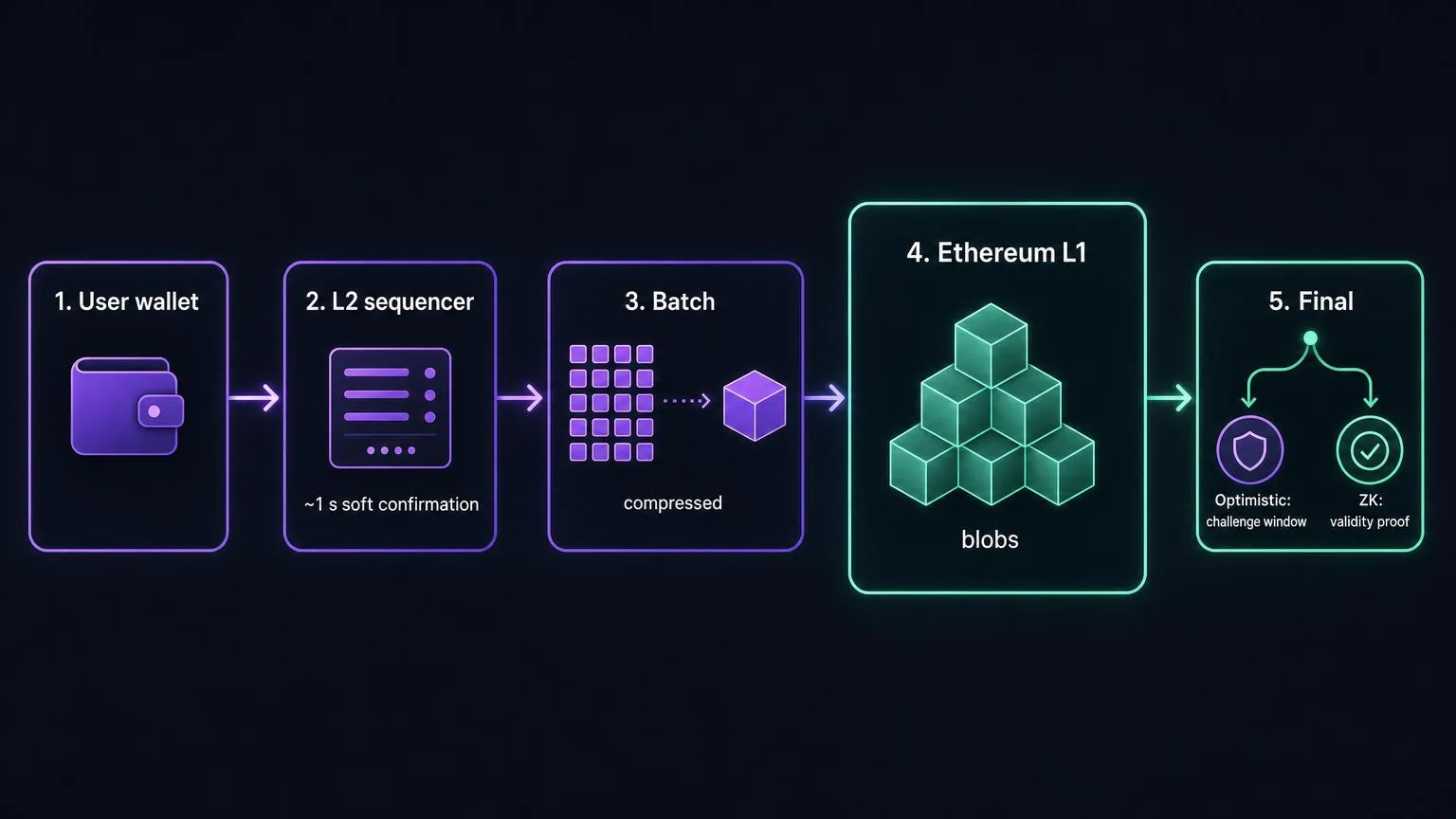
- Wallet → sequencer. Your wallet sends the transaction to the L2's RPC. The sequencer orders it and returns a result within about a second — a "soft" confirmation that relies on trusting the sequencer.
- Sequencer → batch. The batch poster compresses many transactions and posts them to Ethereum, in blobs where enabled or as calldata. Once that Ethereum transaction is final, the L2 transactions are final too.
- State claim. A proposer publishes a claim about the new L2 state on Ethereum.
- Proof or challenge. On an optimistic rollup the claim becomes final if nobody proves fraud during the window; on a ZK rollup, once the validity proof is verified.
- Withdrawal. After the claim is final, the withdrawal message can be executed on Ethereum.
If a sequencer ignores your transaction, rollups let you submit it directly through Ethereum. On Arbitrum One the sequencer can delay such a transaction for at most 24 hours; on Base, force inclusion can take up to 12 hours.
Why L2 fees are so low
The biggest change came from blobs (EIP-4844) — a separate, cheap space for rollup data that Ethereum keeps for about 18 days and then prunes. Each upgrade has added more of it:
| Upgrade | Date on mainnet | Blobs per block (target / max) |
|---|---|---|
| Dencun | March 13, 2024 | 3 / 6 |
| Pectra | May 7, 2025 | 6 / 9 |
| Fusaka (PeerDAS) | December 3, 2025 | 6 / 9, plus a mechanism for blob-only forks |
| BPO1 | December 9, 2025 | 10 / 15 |
| BPO2 | January 7, 2026 | 14 / 21 |
Demand is currently below that capacity, so blob space is almost free: on a typical day in October 2026 about 42 chains post roughly 3.8 GB of data to Ethereum and pay about $66 in total for it (growthepie). The next upgrade, Glamsterdam, has been running on the Sepolia testnet since October 6, 2026; its mainnet date has not been set yet.
Median transaction cost in October 2026 (growthepie, 24-hour average):
| Network | Median transaction | Median swap |
|---|---|---|
| Ethereum L1 | ≈ $0.051 | ≈ $0.17 |
| Arbitrum One | ≈ $0.0043 | ≈ $0.011 |
| Base | ≈ $0.0017 | ≈ $0.0033 |
| Linea | ≈ $0.015 | — |
| ZKsync Era | ≈ $0.019 | — |
Even with a cheap L1, the difference is still roughly 10–30× in favour of the large L2s.
L3: chains on top of L2s
An L3 settles to an L2 instead of to Ethereum directly. The most common kind is an Arbitrum chain (formerly "Orbit") that settles to Arbitrum One — for example ApeChain, Xai or EDU Chain. Getting funds in normally takes two hops (L1 → L2 → L3), although Arbitrum offers a one-transaction "teleport" from Ethereum to an L3. Getting funds out means clearing the L3's own withdrawal process and then the L2's.
Why build one at all? As Vitalik Buterin put it in 2022, data "can be compressed once, but it cannot be compressed again", so stacking the same rollup design does not multiply scalability. L3s make sense for custom functionality (privacy, a custom gas token), custom scaling for a single application, or cheaper, weaker-trust setups — usually by moving data off-chain to a committee.
L2BEAT tracks 13 active L3s, and most of them are small: Xai secures about $0.6 million, ApeChain about $18 million. Several L3s have shut down or been archived (Degen Chain, B3, Sanko), and ZKsync has deprecated its Gateway settlement layer and moved its chains back to Ethereum. The largest "L3" on L2BEAT, Hyperliquid (about $6.7 billion), is listed that way only because its main bridge lives on Arbitrum — Hyperliquid itself is an L1 with its own HyperBFT consensus. More on that in "HyperEVM or Hyperliquid blockchain".
The layer-2 market in numbers
According to L2BEAT in October 2026:
- 96 active projects: 83 L2s and 13 L3s.
- $41.05 billion of total value secured (TVS) on L2s — down from $54.0 billion a year earlier and from the chart's all-time high of $66.5 billion (December 9, 2024), largely because ETH fell from about $3,980 to about $2,450.
- Only 6 L2s are Stage 1 (Arbitrum One, Base, Ink, OP Mainnet, Starknet, Unichain) and 4 are Stage 2 — all of them small. 59 of 83 L2s are in "Others".
| # | Network | L2BEAT type | Stage | TVS |
|---|---|---|---|---|
| 1 | Base | Optimistic rollup | Stage 1 | $15.56B |
| 2 | Arbitrum One | Optimistic rollup | Stage 1 | $10.46B |
| 3 | Polygon PoS | Others (sidechain) | — | $3.80B |
| 4 | Robinhood Chain | Others | below Stage 0 | $2.40B |
| 5 | OP Mainnet | Optimistic rollup | Stage 1 | $2.02B |
| 6 | Mantle | ZK rollup | Stage 0 | $1.33B |
By activity, Base is the clear leader among general-purpose EVM L2s with about 8.9 million operations per day, followed by Robinhood Chain with about 6.9 million (30-day average). The background on that chain is in "Why has the Robinhood blockchain become so popular?"
Where the networks on ChainTx.Tools fit
ChainTx.Tools works with 29 EVM networks. Here is how they map to the layers (L2BEAT and official documentation, October 2026):
| Group | Networks |
|---|---|
| L1 (12) | Ethereum, BNB Chain, Avalanche C-Chain, Monad, Arc, HyperEVM, Sei, Plasma, Sonic, Flare, Berachain, Kaia |
| Sidechains (2) | Polygon PoS, Gnosis |
| Optimistic rollups, Stage 1 (5) | Arbitrum One, OP Mainnet, Base, Unichain, Ink |
| ZK rollups, Stage 0 (5) | ZKsync Era, Abstract, Linea, Mantle, Katana |
| Optimium (1) | Celo |
| L2s in L2BEAT "Others" (4) | Robinhood Chain, World Chain, X Layer, MegaETH |
| L3 | none |
For our tools the layer makes little practical difference: an address on any EVM network is the same key pair, and the Token Creator, One-to-Many sender and RPC checker work the same way on an L1 and an L2. What changes is the gas token, the fees and how long a withdrawal to Ethereum takes. The full list is on the supported networks page, and the market picture is in "Which EVM blockchains are still popular in 2026?"
A network's classification is not permanent. Celo moved from an L1 to an L2 on March 26, 2025; Mantle became a ZK rollup on April 16, 2026; X Layer moved from Polygon CDK to the OP Stack in late 2025; Base left the OP Superchain for its own stack in 2026. Always check the date of a classification.
Common misconceptions
- "Polygon PoS is an L2." It is a sidechain: it checkpoints to Ethereum, but Ethereum does not verify its state transitions. The same goes for Gnosis Chain.
- "L0 is a blockchain under L1." Messaging protocols such as LayerZero are contracts on top of existing chains; Ethereum has no L0 underneath it.
- "Every L2 inherits Ethereum's security." Only rollups with a working proof system and data on Ethereum come close — and 59 of 83 L2s are in "Others".
- "ZK rollups are always safer than optimistic ones." All five EVM ZK rollups supported by ChainTx.Tools are Stage 0, while the five optimistic ones are Stage 1. Upgrade keys matter as much as the proof type.
- "A withdrawal from an L2 always takes 7 days." It ranges from about a day to about a week on optimistic rollups and is limited only by proof frequency on ZK rollups.
- "Blobs keep L2 data on Ethereum forever." Blobs are pruned after about 18 days; long-term history is kept by rollup operators and archive services.
- "An L3 is always cheaper than an L2." Data cannot be compressed twice; L3s get cheaper mostly by moving data off-chain, which adds trust assumptions.
Summary
L1s do everything themselves; L2s borrow Ethereum's data availability and settlement and do execution on their own; L3s repeat the trick on top of an L2; and "L0" is either a shared-security base network or a cross-chain messaging protocol, depending on who is talking. In practice the label matters less than three questions: where the data lives, who can prove that the state is correct, and who can upgrade the contracts. L2BEAT's categories and Stages answer exactly those questions — check them before you bridge serious money to a new network.
FAQ
+Is Ethereum an L1 or an L0?
Ethereum is an L1. It does execution, consensus, data availability and settlement itself and serves as the settlement and data layer for rollups. There is no L0 underneath Ethereum.
+Is Polygon an L2?
Polygon PoS is a sidechain, not a rollup: it has its own validators and checkpoints to Ethereum, but Ethereum does not verify its state transitions. L2BEAT lists it under "Others".
+What is the difference between optimistic and ZK rollups?
Optimistic rollups assume batches are valid and give anyone a challenge window to prove fraud, so withdrawals take from about a day to about a week. ZK rollups attach a validity proof that Ethereum verifies, so there is no challenge window.
+Why are L2 transactions so cheap?
Many transactions are compressed into one batch, so the fixed Ethereum cost is shared, and since 2024 rollups post their data into blobs — a separate, cheap data space. In October 2026 all blob users together pay about $66 a day for roughly 3.8 GB of data.
+Is LayerZero a blockchain?
No. LayerZero is a cross-chain messaging protocol: smart contracts deployed on existing chains plus off-chain verifier networks. The name refers to its role in connecting chains, not to a blockchain layer below L1.
+Does the layer of a network matter when I use ChainTx.Tools?
Not for how the tools work: an EVM address and its key are the same on every network, and token creation, bulk sending and RPC checks work identically on L1s and L2s. What differs is the gas token, the fees and how long a withdrawal to Ethereum takes.