Bitwise Sees Bitcoin Reaching $1.6 Million by 2036
Bitwise has published its long-term bitcoin outlook: a base case of $1.6 million per BTC by 2036, or 34.3% a year. We walk through the report's numbers, the bear and bull cases, how the model works and the risks the authors themselves name.
 Antonio Vaganovs·Published ·8 min read
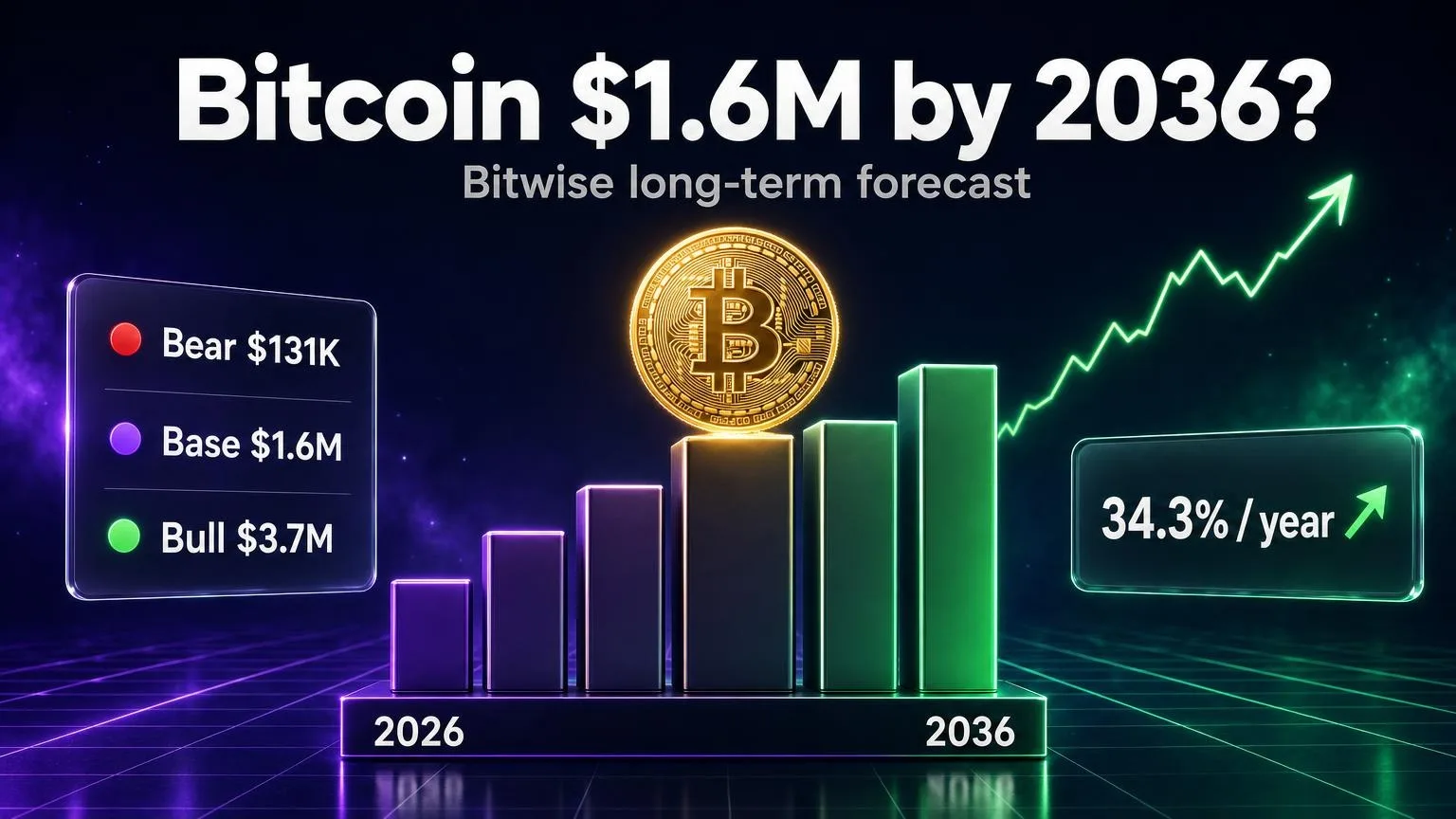
On October 28, 2026, Bitwise Asset Management published its 2027 Bitcoin Long-Term Capital Market Assumptions, a 10-year outlook for bitcoin. The headline number: in its base case, bitcoin is worth $1,599,766 in 2036, or about $1.6 million. That is a compound annual growth rate of 34.3% from $83,557, the price on September 30, 2026.
A year ago, Bitwise expected $1.3 million by 2035 and 28.3% a year. The authors say they raised the forecast because the markets bitcoin serves keep growing and their confidence in its long-term trajectory has increased.
The report was written by Chief Investment Officer Matt Hougan, Head of Research Ryan Rasmussen and analysts Juan Leon, Josh Carlisle and Camran Khosravi. The full version is a PDF on the Bitwise website.
Every figure below comes from the report. Bitwise itself notes that its valuation framework and price targets are illustrative and do not guarantee future results. The company runs crypto exchange-traded products, so a rising market benefits it. This article reports the news and is not investment advice.
The key numbers
| Assumption for 2026–2036 | Bitwise forecast |
|---|---|
| BTC price in 2036, base case | $1,599,766 |
| Compound annual growth rate (CAGR) | 34.3% |
| Average volatility | 27.8% |
| Average correlation to U.S. stocks | 0.43 |
| Bitcoin's share of institutional portfolios | 1–5% |
| Institutional inflows | $1.5–7.4 trillion |
Bitwise expects bitcoin to be the best-performing major asset of the next decade and also the most volatile, although its volatility should keep falling.
Three scenarios: from $131K to $3.7M
Besides the base case, the report has a bear case and a bull case. Bitwise relies on the base case, which it considers the most likely outcome. The other two show how uncertain the forecast is.
| Scenario | BTC price in 2036 | Annual growth |
|---|---|---|
| Bear | $130,686 | 4.6% |
| Base | $1,599,766 | 34.3% |
| Bull | $3,667,911 | 46.0% |
Even in the bear case, the price in 10 years is higher than today. In that scenario, bitcoin takes only 2.5% of the store-of-value market and nothing from the other markets.
How Bitwise gets to the price
Bitwise uses a total addressable market (TAM) model. It estimates how big the markets bitcoin can serve will be in 2036 and what share of each bitcoin will capture. The total is divided by bitcoin's full supply of 21 million coins. The authors call this a conservative choice: not every coin will be mined by 2036, and a significant portion is assumed to be lost.
| Market | Today, $ trillion | Annual growth | In 2036, $ trillion | BTC share: bear / base / bull |
|---|---|---|---|---|
| Institutional investment assets | 139.7 | 7.5% | 303.5 | 0% / 1% / 5% |
| Emerging market currencies | 64.7 | 8.5% | 146.1 | 0% / 1% / 2.5% |
| Store of value (gold, bitcoin) | 31.1 | 14.1% | 109.8 | 2.5% / 25% / 50% |
| Offshore wealth | 13.0 | 3.0% | 19.0 | 0% / 5% / 10% |
| National treasury reserves | 14.2 | 2.3% | 18.1 | 0% / 2.5% / 5% |
| U.S. corporate treasuries | 5.4 | 5.0% | 8.9 | 0% / 2.5% / 5% |
| Global remittances | 0.7 | 5.2% | 1.3 | 0% / 2.5% / 5% |
One row does almost all the work: the store-of-value market. By our arithmetic, 25% of $109.8 trillion is $27.5 trillion out of the roughly $33.6 trillion the base case assigns to bitcoin. Divide $33.6 trillion by 21 million coins and you get the $1.6 million per BTC.
Bitwise extends that market at its growth rate of the past 10 years, from $31 trillion to $110 trillion. The authors add that the estimate could prove conservative if worries about currency debasement grow. Institutional assets in the model are cut by 5% for the gold institutions already hold: $139.7 trillion instead of BCG's $147 trillion.
Three reasons for growth, according to Bitwise
1. Institutional demand. According to Boston Consulting Group, institutional investors control about $147 trillion. If they put 1–5% of their portfolios into bitcoin over the decade, they will need to buy $1.5–7.4 trillion of BTC. The network only produces about $14 billion of new bitcoin a year. U.S. spot bitcoin ETPs already hold $108 billion in assets less than three years after launch, and in 2026 several of the largest wealth management platforms approved them.
2. Limited supply. There will never be more than 21 million bitcoin, and 20.1 million (95.7%) are already in circulation. Bitcoin's annual inflation is 0.8% today. Under its fixed issuance schedule, it falls to 0.4% in 2028 and 0.2% in 2032. Gold's is about 2%. No matter how much demand rises, no more bitcoin gets produced, unlike gold or oil.
3. Fiat debasement. U.S. federal debt has reached $40.2 trillion, and interest on it costs $1.1 trillion a year, the third-largest line in the budget. The deficit for fiscal 2026 was $2.0 trillion, or 6.2% of GDP. Bitwise expects governments to handle their debt by debasing their currencies, which would raise demand for hard assets such as gold and bitcoin.
The authors already see signs of this:
- the dollar's share of global foreign exchange reserves fell from 71.0% in 1999 to 56.7%;
- central banks bought a record $96 billion of gold in 2025;
- more than a dozen countries, including the U.S., now hold bitcoin reserves.
Volatility, correlations and the four-year cycle
Volatility. The model uses an average volatility of 27.8%, the midpoint between today's level and the level Bitwise expects in 2036. It will likely run higher in the next few years and lower toward the end of the period. The authors expect volatility to keep falling, but half as fast as before, because the biggest risks around regulation, custody and liquidity have largely been addressed already.
Correlations. Over the past 10 years, bitcoin's average correlation was 0.25 to U.S. stocks, 0.02 to bonds and 0.11 to gold. For the next decade, Bitwise assumes 0.43 to stocks, 0.05 to bonds and 0.21 to gold. The link with gold is already getting stronger: on September 11, 2026, the 90-day correlation hit a record 0.58.
The cycle. Historically, bitcoin has moved in four-year cycles. The last peak was $126,080 on October 6, 2025, followed by a fall to $58,717 by June 30, 2026, a 53.4% drop. If that low holds, it will be the shallowest cyclical retracement in bitcoin's history: in earlier cycles the price fell 86%, 84% and 77%. Bitwise expects the cycle to weaken but not disappear completely.
Bitcoin vs. other assets
For comparison, Bitwise averaged the long-term forecasts of JPMorgan, PGIM, BlackRock and Vanguard for traditional assets. Their horizons range from 5 to 10 years, so the comparison is approximate.
| Asset | Annual return | Volatility | Correlation to BTC |
|---|---|---|---|
| Bitcoin | 34.3% | 27.8% | — |
| Private equity | 10.8% | 22.0% | 0.39 |
| Private credit | 8.1% | 11.8% | 0.30 |
| Hedge funds | 7.8% | 7.2% | 0.19 |
| U.S. stocks | 6.7% | 16.9% | 0.43 |
| Real estate | 6.7% | 17.6% | 0.18 |
| Gold | 5.5% | 17.2% | 0.21 |
| U.S. bonds | 5.0% | 5.3% | 0.05 |
| Commodities | 4.9% | 16.4% | 0.02 |
How the forecast compares
Bitwise sets its number against other analysts' estimates:
- AllianceBernstein expects bitcoin to cross $1 million by 2033;
- Standard Chartered expects it to cross $500,000 by 2030;
- ARK Invest's bull case is roughly $1.2 million by 2030;
- Strategy's Michael Saylor names $21 million by 2046.
34.3% a year is well below what bitcoin has delivered so far: its 10-year CAGR is 63.5%. From the start of 2020 to September 30, 2026, bitcoin rose 1,069%, more than any other major asset. Gold gained 174% over the same period.
The risks the authors name
Bitwise says plainly that forecasting bitcoin's returns, volatility and correlations is uncertain and prone to error. The main risks it lists:
- A short track record. Bitcoin has traded on exchanges since 2010 and spot ETPs only arrived in 2024, so there is little data to model.
- Regulation. The friendly environment may not last. In 2026 the Clarity Act, an important U.S. crypto bill, failed to advance in Congress, largely because Democrats considered its ethics provisions too weak.
- Adoption. Buying by institutions, companies and governments is a new trend, and it may not continue.
- Technology and quantum computing. Rapid progress in quantum computing, or AI-accelerated breakthroughs in mathematics, could threaten bitcoin's cryptography. The network will likely need to move to resistant cryptography, and holders will need to move coins to new addresses.
- Other risks: macroeconomics, trading and self-custody.
What it means in practice
On October 29, 2026, bitcoin trades around $80,000 on Bybit, slightly below the price Bitwise started from. To reach $1.6 million it would have to rise about 20-fold. At that price one satoshi would be worth $0.016, and $100 would buy 6,250 sats. You can convert BTC to sats and back with our bitcoin unit converter and compare live prices and spreads on the Bybit prices page.
A 10-year forecast is not a promise. Even inside Bitwise's own model, the range runs from $131,000 to $3.7 million per BTC. And as the authors warn, bitcoin remains a cyclical asset, so deep drawdowns are possible on the way to any of these numbers.
FAQ
+What did Bitwise forecast for bitcoin?
In its 2027 Bitcoin Long-Term Capital Market Assumptions, published on October 28, 2026, Bitwise's base case is $1,599,766 per bitcoin in 2036, or about $1.6 million. That is a compound annual growth rate of 34.3% from $83,557, the price on September 30, 2026.
+What other scenarios does the report include?
A bear case of $130,686 per BTC in 2036 (4.6% a year) and a bull case of $3,667,911 (46.0% a year). Bitwise treats the base case as its main forecast, and the other two show how uncertain it is.
+Why is the forecast higher than last year's?
A year ago Bitwise expected $1.3 million by 2035 and 28.3% a year. It attributes the increase to the growth of the markets bitcoin serves, above all the store-of-value and institutional investment markets, and to greater confidence in bitcoin's long-term trajectory.
+What is Bitwise's model based on?
On a total addressable market (TAM) estimate. Bitwise projects the size of seven markets in 2036, assigns bitcoin a share of each and divides the total by 21 million BTC. The store-of-value market contributes the most: in the base case, bitcoin takes 25% of $109.8 trillion.
+What risks does Bitwise name?
Bitcoin's short track record, a change in regulation, a possible slowdown in institutional adoption and technological threats, above all quantum computing and AI-driven advances in mathematics. It also mentions macroeconomic, trading and self-custody risks.
+Does this mean bitcoin is worth buying?
No. This is one asset manager's forecast, and the company itself calls its price targets illustrative. Bitcoin remains a volatile asset, and investment decisions are yours to make, taking into account the risk of large losses.