How to Create Your Own Memecoin on Solana: A Step-by-Step Guide
Two ways to launch a memecoin on Solana without code: on the Pump.fun bonding curve or as your own token with your own liquidity pool. Step by step in ChainTx.Tools, with real costs in SOL, the settings buyers check and what to do after launch.
 Antonio Vaganovs·Published ·10 min read
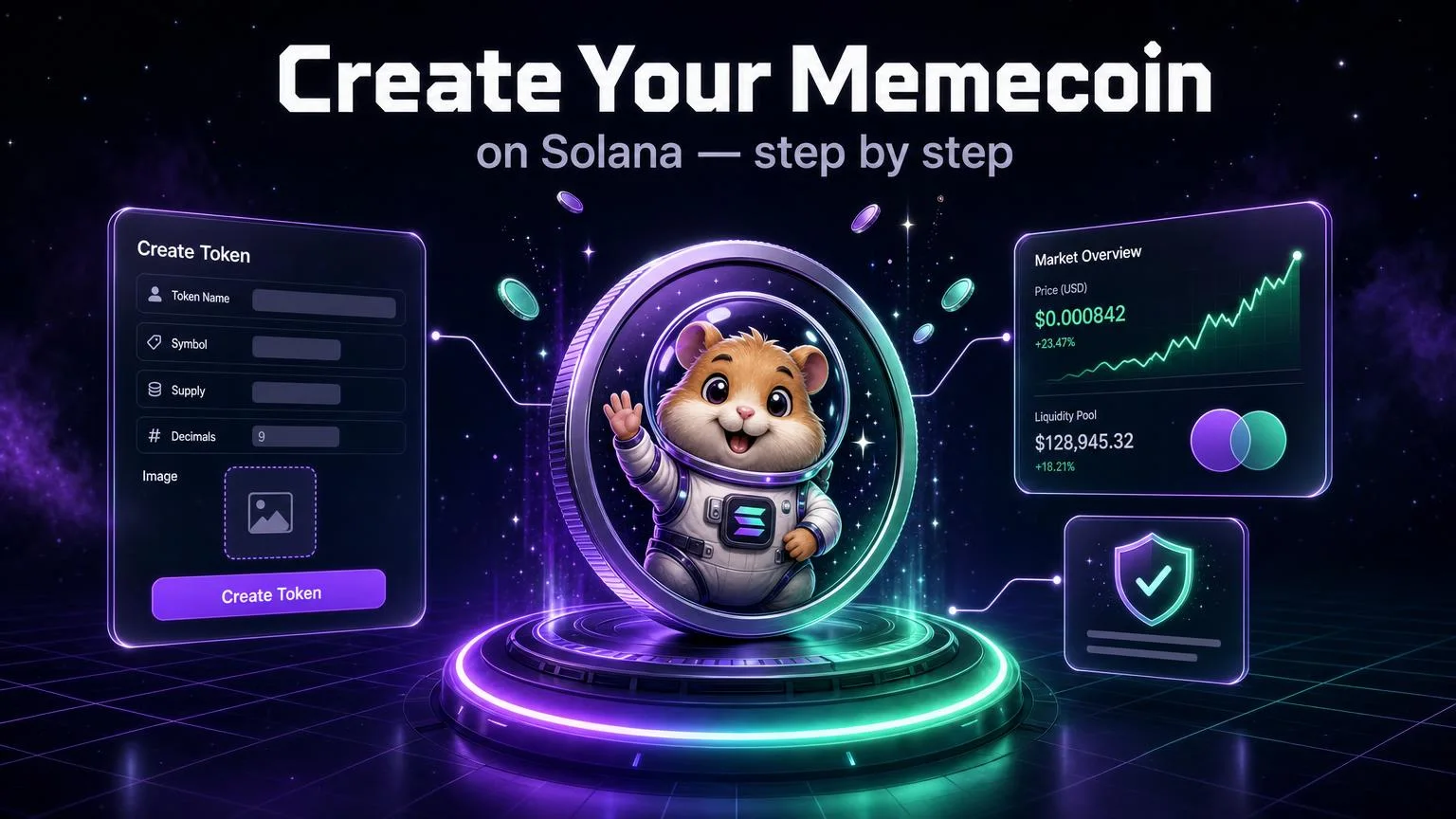
A memecoin on Solana is technically simple: a fungible token (SPL or Token-2022), its metadata with a name, ticker and logo, and a market where people can trade it. Creating the token takes a minute and costs a fraction of a SOL. What decides whether a launch looks trustworthy is everything around it: the settings you pick, how the first liquidity is set up and what you do in the first hours after launch.
This guide walks through both ways to launch a memecoin on Solana without writing code, using the ChainTx.Tools tools: on the Pump.fun bonding curve, or as your own token with your own liquidity pool. All screenshots are taken from the live tools with an example token, Lunar Hamster (LHAM).
A Solana wallet (Phantom, Solflare, Backpack or any other), some SOL, an original name and ticker, a square logo, a short description and links to your X account, Telegram or website. Creating the token itself needs about 0.11 SOL; your own pool needs more (see the costs below).
Two ways to launch
| Pump.fun bonding curve | Your own token + pool | |
|---|---|---|
| Starting liquidity | Not needed: trading starts on the curve | You deposit SOL and tokens |
| Supply and decimals | Fixed: 1,000,000,000 and 6 | Your choice (default 1,000,000,000 and 6) |
| Mint and freeze authority | None | Off by default in our creator |
| ChainTx.Tools fee | 0.1 SOL | 0.1 SOL for the token + 0.1 SOL per pool action |
| Network cost of creation | ≈ 0.0064 SOL | ≈ 0.005 SOL (Token-2022), ≈ 0.017 SOL (SPL) |
| After launch | Curve until about 85 SOL, then PumpSwap | Your pool from the first minute |
| Control | Little: the curve sets the price | Full: DEX, opening price, LP |
Pump.fun suits you if you have little capital and want to see whether a community forms around the idea: you pay for creation only, and buyers provide the liquidity. Your own pool suits a token with a custom supply, a planned treasury or a team that wants to control the venue, the opening price and the liquidity lock from day one.
Before you start
- Name and ticker. Make them original. Copying a trending token's name, ticker or logo gets you flagged by wallets and aggregators.
- Logo. A square PNG, WEBP or JPG; the creator resizes it to 512×512.
- Description and links. One or two sentences about the idea, plus X, Telegram and a website if you have them. They go into the token's metadata.
- Wallet. Many creators use a fresh wallet for the deployment. You can generate one locally in the Solana wallet creator.
- Budget in SOL. The tools show the exact cost before you sign anything, and the token creator refuses to start if your balance cannot cover it.
Route A: launch on Pump.fun
- Open the Solana Token Creator, connect your wallet and choose the Pump.fun token type. Pump.fun coins always have a supply of 1,000,000,000 with 6 decimals, so those fields disappear.
- Enter the name and symbol, upload the icon and choose where to store it and the metadata: IPFS through Pinata (recommended, the link is tied to the file's content) or the ChainTx server.
- Add the description and links.
- Initial dev buy (SOL) is optional: it buys your own coin at launch. Keep it modest: a large creator share is visible on-chain and scares buyers.
- Mayhem mode is an optional Pump.fun launch mode. Read Pump.fun's own description before you turn it on.
- Click Create Token and confirm in your wallet. You pay the 0.1 SOL service fee and about 0.0064 SOL of network costs, plus the dev buy if you set one.
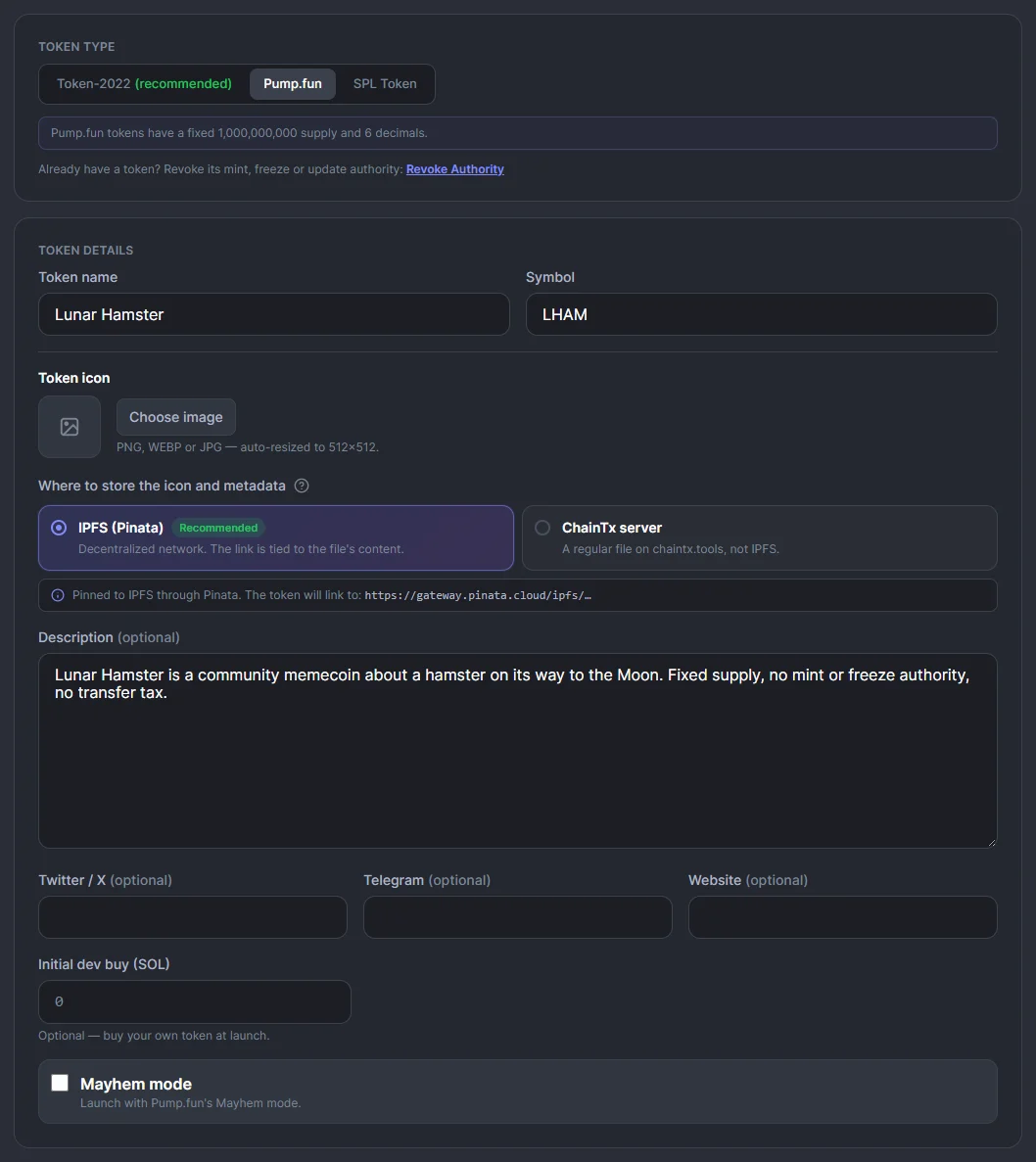
After creation the coin trades on Pump.fun's bonding curve. When the curve fills up, at about 85 SOL of real SOL by our calculation, it migrates to PumpSwap and the liquidity there is locked by the protocol. Pump.fun coins have no mint or freeze authority, so there is nothing to revoke.
The Bundler can create a Pump.fun or LetsBonk coin and buy it from several of your wallets in one Jito bundle, for 0.3 SOL per launch. Keep in mind that scanners such as Bubblemaps show bundled supply as a cluster, and many buyers treat that as a red flag. We explain why in the most common token launch mistakes.
Route B: your own token and liquidity pool
Step 1. Create the token
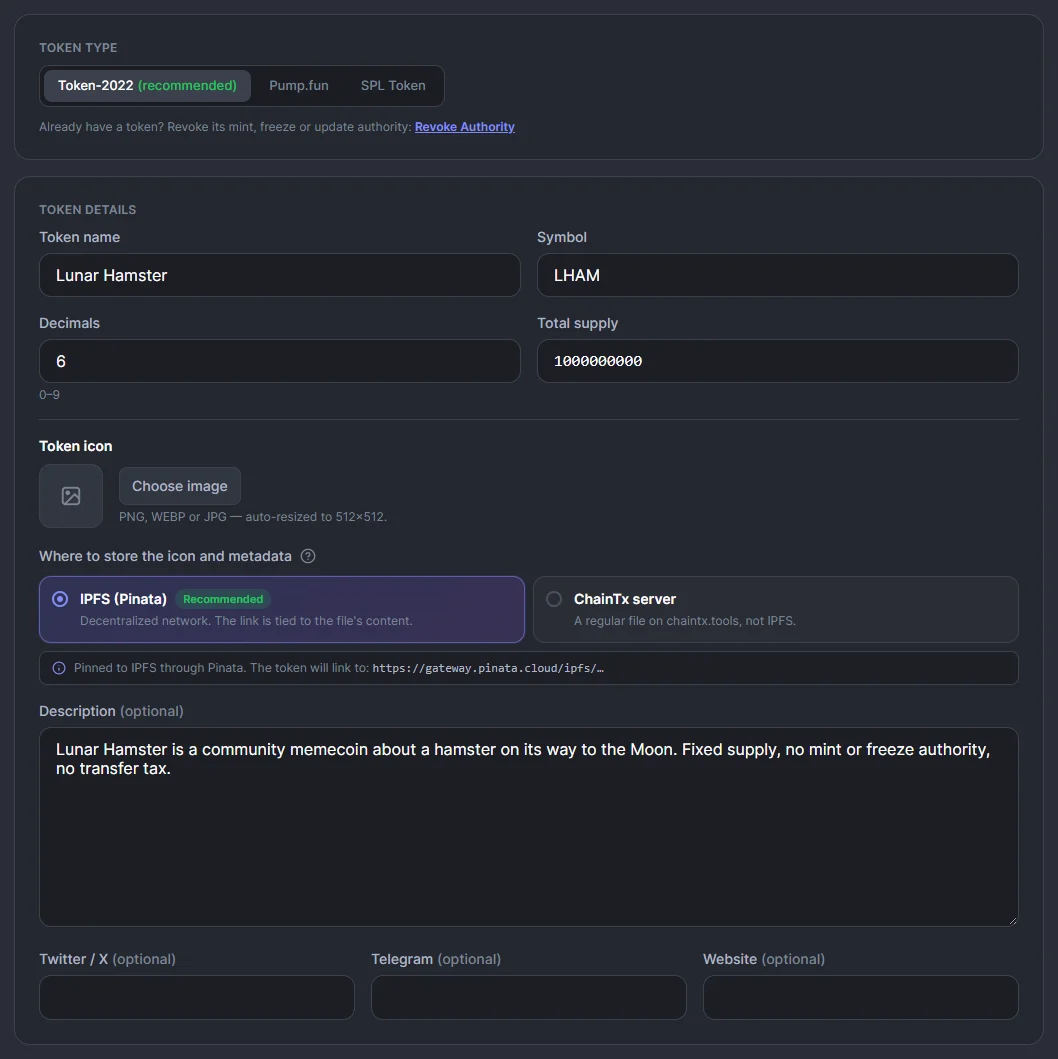
Open the Solana Token Creator and keep the Token-2022 type, which is preselected. Choose SPL Token only if you need a venue or tool that does not support Token-2022 yet, such as Raydium AMM v4. The differences are covered in SPL Token vs Token-2022.
- Name (up to 32 characters) and symbol (up to 10).
- Decimals and total supply default to 6 and 1,000,000,000, the de facto memecoin standard. The creator checks that the supply fits Solana's u64 limit.
- Icon and the storage for the icon and metadata.
- Description and links.
Step 2. Keep the authorities off and skip the transfer fee
In the Features block, mint authority and freeze authority are off by default. Leave them off:
- No mint authority means a fixed supply: nobody can print new tokens later.
- No freeze authority means nobody can lock a holder's tokens.
Both are among the first things buyers and scanners such as RugCheck check, as we explain in What Are Mint and Freeze Authority on Solana? Leave the transfer fee at 0 as well: a tax on every transfer scares traders, and many DEXes and CEXes avoid fee-on-transfer tokens.
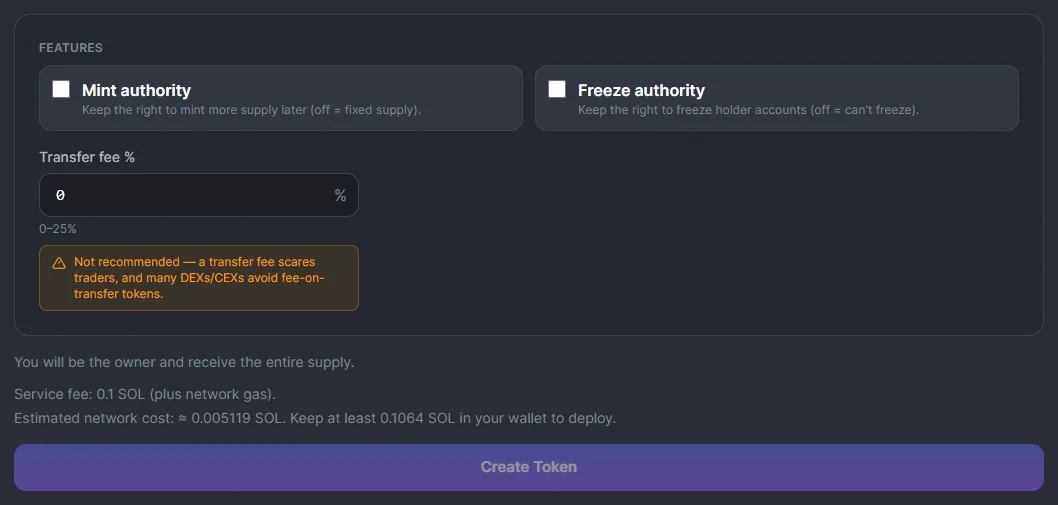
Under the button the creator shows the service fee (0.1 SOL) and the estimated network cost (about 0.005 SOL for Token-2022) and tells you how much to keep in the wallet. A pre-flight check stops the launch before anything is charged if your balance is too low. A Token-2022 token is created in a single transaction, and the whole supply lands in your wallet. If the creation fails after the fee was paid, the fee is not charged again for the same wallet for an hour.
Step 3. Create the liquidity pool
Open the Solana Liquidity Pool Manager, connect the wallet that holds the tokens and choose the DEX:
- Raydium CPMM (preselected): a constant-product pool with LP tokens and Token-2022 support. Raydium's guides recommend it for new tokens.
- Meteora DAMM v2: a constant-product pool with position NFTs and fee schedules that start high to discourage snipers.
- Raydium CLMM and Meteora DLMM: concentrated liquidity in a price range, better for established pairs than for price discovery.
- Raydium AMM v4 (classic SPL tokens only) and PumpSwap.
Set Token A to SOL (or USDC/USDT), paste your mint address as Token B and enter both amounts. The ratio of the amounts is the opening price. For example, 20 SOL and 200,000,000 LHAM give a price of 0.0000001 SOL per token, which values the whole 1,000,000,000 supply at 100 SOL.
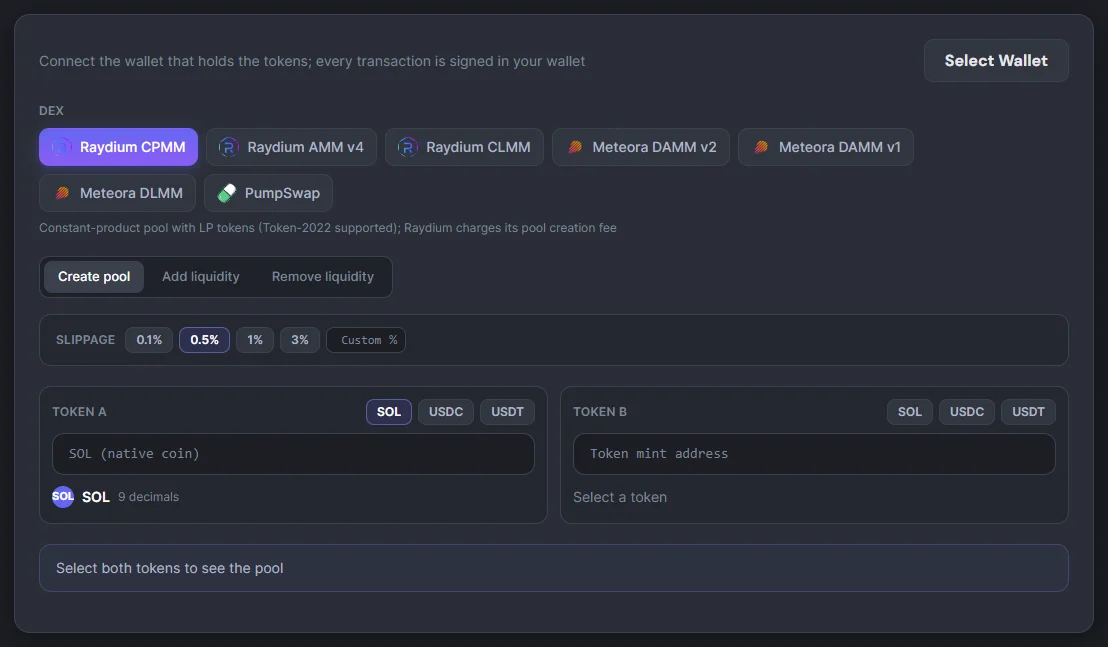
Pool size matters more than people expect. With 5 SOL in a constant-product pool, a single 1 SOL buy moves the price by about 44%; with 20 SOL, by about 10%. The pool action costs 0.1 SOL in service fees plus the DEX's own creation fee (0.15 SOL on Raydium CPMM) and a little rent, and the tool shows the total before you sign.
Step 4. Lock the LP and lock the metadata
- LP. Whoever holds the LP tokens can withdraw the liquidity at any moment, so buyers look for a burn or a lock. Raydium's Burn & Earn locks CPMM LP forever while you keep collecting the trading fees; Meteora DAMM v2 positions can be locked permanently. Our liquidity tool does not lock LP, so do this step in Raydium or Meteora.
- Metadata. Once the logo and links are final, make the token immutable. In Revoke Authority you paste the mint address, see which authorities are still active and revoke the metadata update authority. The same transaction can also revoke a mint or freeze authority you kept. It costs 0.05 SOL per transaction.
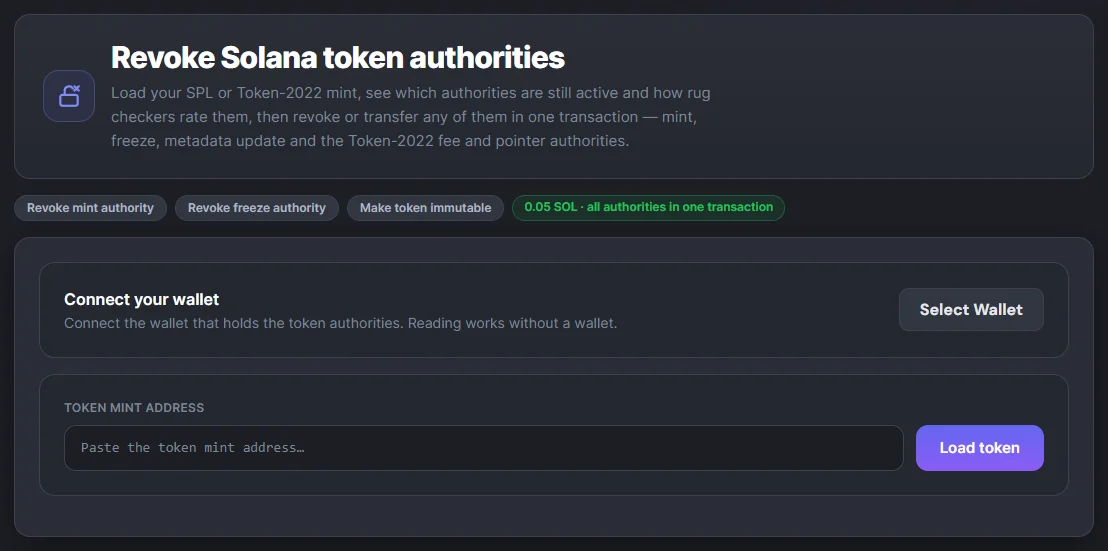
A revoked authority cannot be restored by anyone. Make the metadata immutable only after you have checked the logo and links in a couple of wallets.
After the launch
- Check how the token looks. DexScreener picks up a pool after its first trade. Jupiter's token verification is free in the standard queue and values a project-dedicated X account with organic engagement. RugCheck should show no warnings about authorities or unlocked LP.
- Distribute allocations. Airdrops, team or marketing wallets go out in one run with the one-to-many sender. Our guide to bulk transfers shows how.
- Watch the wallets. The bulk balance checker is free and shows the balances of hundreds of addresses at once.
- Support the market, do not fake it. The market maker can keep a pool active, but wash trading is easy to spot and Jupiter's organic score filters it out. Our market maker cookbook explains how memecoin markets actually work.
How much it costs
| Item | Pump.fun | Your own token + pool |
|---|---|---|
| ChainTx.Tools fee for the token | 0.1 SOL | 0.1 SOL |
| Network cost of creation | ≈ 0.0064 SOL | ≈ 0.005 SOL (Token-2022) / ≈ 0.017 SOL (SPL) |
| Dev buy | Optional, any amount | — |
| Pool creation | — | 0.1 SOL (ChainTx.Tools) + 0.15 SOL (Raydium CPMM) + rent |
| Liquidity | — | Your SOL and tokens, e.g. 20 SOL |
| Revoke / make immutable | Not needed | 0.05 SOL per transaction |
| LP lock | Done by the protocol at migration | Raydium Burn & Earn: network fee only |
Network costs depend on the current rent and fees; the tools always show them before you sign. All ChainTx.Tools service fees are listed on the pricing page.
A Token-2022 memecoin with a fixed supply, a Raydium CPMM pool and a burned LP costs about 0.4 SOL in fees on top of the liquidity itself.
Mistakes that sink most launches
- Leaving the mint or freeze authority active.
- A pool with a few SOL in it, where every buy moves the price by tens of percent.
- LP that is not burned or locked.
- Buying your own launch from many fresh wallets.
- Copying another token's name or ticker.
- A transfer tax or other risky Token-2022 extensions.
Each of them is visible on-chain within minutes. We collected them, with the consequences and fixes, in The Most Common Mistakes When Launching Your Own Token on Solana.
Memecoins are highly speculative, and most of them lose almost all their value. Do not promise buyers profits, buybacks or rewards, and check the rules of your country before launching a token with a team, a treasury or a roadmap.
Summary
Creating a memecoin on Solana takes a few minutes and about 0.1 SOL in our tools. Choose Pump.fun to test an idea without capital, or your own token and pool for full control. In both cases, the settings buyers check first are the same: no mint or freeze authority, no transfer tax, enough liquidity, a locked LP, immutable metadata and an honest launch.
FAQ
+How much does it cost to create a memecoin on Solana?
In ChainTx.Tools the token itself costs a 0.1 SOL service fee plus about 0.005 SOL of network costs for Token-2022 (about 0.017 SOL for a classic SPL token, about 0.0064 SOL for a Pump.fun coin). A pool of your own adds 0.1 SOL in service fees, the DEX's creation fee (0.15 SOL on Raydium CPMM) and the liquidity you deposit.
+Do I need to know how to code?
No. You fill in a form in the browser and confirm the transactions in your wallet (Phantom, Solflare, Backpack or another Solana wallet). The tools build the transactions; your keys never leave your wallet.
+Should I launch on Pump.fun or create my own pool?
Pump.fun needs no starting liquidity: buyers trade on a bonding curve, and the coin moves to PumpSwap when the curve fills at about 85 SOL. Your own pool needs SOL for liquidity but gives you control over the supply, the DEX, the opening price and the LP lock.
+Token-2022 or SPL Token?
Token-2022 is the default in our creator: it stores the metadata in the mint itself and is supported by Raydium CPMM, Meteora and Jupiter. Choose SPL Token only if you need a venue that does not support Token-2022 yet, such as Raydium AMM v4.
+Can I change the supply or the logo later?
The supply can only grow if you kept the mint authority, which we do not recommend for a memecoin: a fixed supply is what buyers expect. The logo and links can be changed until you make the metadata immutable in the Revoke Authority tool.
+Do I receive the whole supply?
With your own token, yes: the entire supply lands in the wallet that created it, and you decide how much goes into the pool. On Pump.fun the tokens sit on the bonding curve, and you only get what you buy, for example with the initial dev buy.
+How does my memecoin get onto DexScreener and Jupiter?
DexScreener lists a pool automatically after its first trade; the logo and links can be added through its token info service. Jupiter verification is free in the standard queue and looks at a project-dedicated X account, the holder distribution and locked liquidity.
+Is a memecoin a security?
In February 2025 the SEC staff said typical memecoins bought for entertainment and speculation are not securities, but a token sold with promises of profits from the team's efforts can be. Do not promise returns, and ask a lawyer if your token has a team, a treasury or a roadmap. This is not legal advice.