What Is Behind the Success of the Monad Blockchain?
Monad launched on November 24, 2025 and reached the top 10 blockchains by TVL in under a year. We explain the technology in plain language, the team, the MON token, the ecosystem numbers as of early October 2026 and the project's weak spots — from token unlocks to volume concentration.
 Antonio Vaganovs·Published ·13 min read
Monad launched its public mainnet on November 24, 2025 — later than most of its competitors and almost four years after development began. Ten and a half months later, its DeFi protocols hold about $1 billion (number 10 among all blockchains on DefiLlama as of October 9, 2026), and its DEXes traded more than $7 billion in August and September alone. Over the same year, the previous wave of "fast EVM chains" — Berachain, Sonic, Sei — lost more than 90% of their TVL.
Yet in early October 2026 the MON token trades below its public sale price, so Monad's success is first of all the success of the network, not the token. Below: what Monad is in plain language, who built it, how the launch went, what the numbers show, and where the project is weak.
The short answer
| Parameter | Monad, early October 2026 |
|---|---|
| Network type | EVM-compatible layer 1 (L1), chain ID 143 |
| Mainnet | since November 24, 2025 |
| Block time and finality | 300 ms and 600 ms (400 and 800 ms until July 23, 2026) |
| Stated capacity | 10,000 transactions per second, 500 million gas per second |
| Actual load | ≈ 61 transactions per second, ≈ 5.3 million per day (October 2–9) |
| Validators | about 200 |
| TVL on DefiLlama | ≈ $998 million, #10 among chains |
| Stablecoins on the network | ≈ $774 million |
| MON token | ≈ $0.024, market cap ≈ $284 million (October 9) |
In short, Monad won on three things: the technology works as promised and the network has never halted; full EVM compatibility let major DeFi protocols simply redeploy their contracts; and the token distribution plus years of community building brought users and liquidity from day one. The weak spots are a heavy unlock schedule, dependence on one DEX, and few real users behind millions of transactions.
What Monad is, in plain language
Monad is an independent blockchain that runs the same bytecode as Ethereum. For users that means the same MetaMask and the same address format; for developers, a Solidity contract moves over without a rewrite. The difference is speed: the team rebuilt the node's internals so the EVM processes a hundred times more gas per second than Ethereum.
The main ideas from the Monad documentation:
- MonadBFT — a consensus protocol in which a block becomes final two blocks later and is protected from tail-forking, where the next leader drops the previous leader's block for its own benefit.
- RaptorCast — blocks travel in erasure-coded chunks, so the leader does not have to send the full block to every validator.
- Asynchronous execution — validators first agree on the order of transactions and only then execute them in a separate pipeline. On Ethereum, execution has to fit into a small slice of the block time; on Monad it gets the whole block time.
- Optimistic parallel execution — a block's transactions run at the same time; if a transaction read data that an earlier one changed, it is re-executed. The result always matches serial execution.
- MonadDb — a custom database that stores the state trie directly on SSD instead of "a tree inside another tree", as LevelDB- or RocksDB-based clients do, and reads the disk asynchronously.
| Ethereum | Monad | |
|---|---|---|
| Block time | 12 s | 0.3 s |
| Finality | ≈ 13 min (two epochs) | 0.6 s |
| Gas per second | ≈ 5 million (60 million per 12 s) | 500 million (150 million per 0.3 s) |
| Contract size | up to 24.5 KB | up to 128 KB |
| Gas charged | gas actually used | the transaction's gas limit |
It is the network's capacity, not its load. We sampled blocks through public archive RPCs: from October 2 to October 9, 2026, a block came every 302 ms on average, held about 18 transactions, and used roughly 10% of the gas limit. That is ≈ 61 TPS and ≈ 5.3 million transactions a day, matching the Monad Foundation's transaction counter for September. The headroom is huge, but real demand has not tested it yet: according to The Block, more than 10,000 TPS was reached only on testnet.
Team and funding
Monad was founded in 2022 by Keone Hon, James Hunsaker and Eunice Giarta. Hon and Hunsaker came from Jump Trading, a high-frequency trading firm where they built ultra-low-latency systems, and that experience shows in the network's architecture. Today the clients are developed by Category Labs (formerly Monad Labs), while the Monad Foundation handles the ecosystem, grants and stake delegation. The code of both clients is open under the GPL-3.0 license.
The project was well funded: about $19 million in early rounds in 2022–2023 led by Dragonfly, and $225 million in April 2024 led by Paradigm with Electric Capital, Coinbase Ventures, Greenoaks and others — at a $3 billion valuation, according to The Block. Time mattered just as much: a devnet went live in March 2024, the public testnet on February 19, 2025, and only then did the team move to mainnet.
Launch and the MON token
| Date | Event |
|---|---|
| February 19, 2025 | Public testnet |
| November 17–22, 2025 | MON public sale on Coinbase |
| November 24, 2025 | Mainnet and start of MON trading |
| July 23, 2026 | MIP-12 upgrade: 300 ms blocks, 600 ms finality |
| October 5, 2026 | MON listed on Robinhood |
The Coinbase sale was the first one on the exchange's new token sale platform. It offered 7.5 billion MON (7.5% of supply) at $0.025, or $187.5 million; bids totaled $269 million from 85,820 participants in more than 70 countries, including the US. A 1.43x oversubscription is modest by market standards: CoinDesk noted that the sale took noticeably longer to fill than other high-profile launches.
The airdrop, announced on October 14, 2025, went to about 5,500 Monad community members and nearly 225,000 users of other ecosystems: active DeFi users, traders on Hyperliquid, Pump.fun and Virtuals, holders of well-known NFTs, and DAO voters. The bet was not on testnet farmers but on people who already live in crypto.
The split of 100 billion MON according to the official tokenomics:
| Category | Share | Terms |
|---|---|---|
| Ecosystem development | 38.5% | unlocked, managed by the Monad Foundation |
| Team | 27% | fully locked for one year, then released over three years |
| Investors | 19.7% | one-year cliff, then 1/48 per month |
| Public sale | 7.5% | circulating from launch |
| Category Labs treasury | ≈ 3.95% | same as investors |
| Airdrop | ≈ 3.3% | circulating from launch |
At launch about 10.8 billion MON (10.8%) was circulating and 50.6% was locked. The block reward was 25 MON at first and 18 MON after the July upgrade; blocks became more frequent, so annual issuance stayed at about 2 billion MON, roughly 2% of the initial supply. The base part of each fee is burned.
MON's all-time high of $0.0488 came on November 26, 2025 (CoinGecko), and in December it fell below $0.017. On October 9, 2026, MON traded at ≈ $0.024, with a market cap of ≈ $284 million and a fully diluted valuation of ≈ $2.4 billion.
The ecosystem in numbers
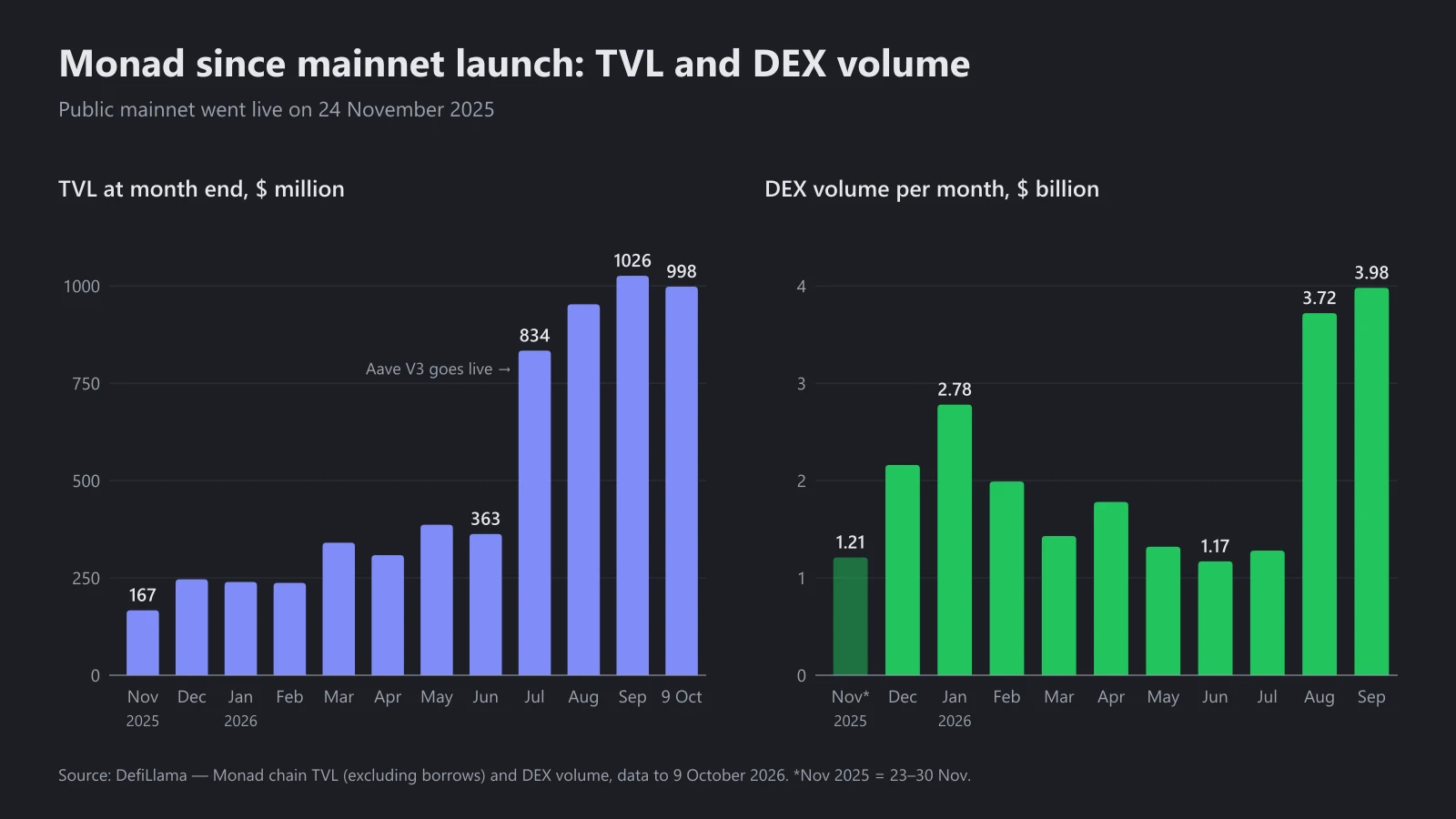
| Month end | TVL | DEX volume in the month | Stablecoins |
|---|---|---|---|
| November 2025 | $167M | $1.21B (from Nov 23) | $237M |
| December 2025 | $246M | $2.16B | $397M |
| June 2026 | $363M | $1.17B | $461M |
| July 2026 | $834M | $1.28B | $636M |
| August 2026 | $953M | $3.72B | $755M |
| September 2026 | $1.03B | $3.98B | $701M |
Data from DefiLlama, TVL excluding borrows; including borrows, the Monad Foundation counts $1.91 billion as of September 30, 2026.
The chart shows two waves. The first is the launch: in December 2025 more than half of DEX volume went through Uniswap V4, and lending relied on Morpho, Euler and Curvance. The second is summer 2026, when DeFi blue chips arrived: Pendle in late June and Aave V3 in early July, with Aave gathering more than $250 million in under a month. By October 9, Aave was the largest protocol on the network ($346 million), followed by Euler ($214 million), Morpho ($176 million) and Pendle ($150 million).
Trading is driven by Kuru, an exchange with a fully onchain order book that Paradigm backed in 2025: in the 30 days to October 9 it handled 54% of all DEX volume on Monad, and Uniswap V4 24%. Among stablecoins, the leaders were USDC ($251 million), Agora's AUSD ($121 million) and Ethena's USDe ($99 million). According to the Foundation's figures as of September 30, the network had more than 4.3 million wallets and 170 apps, and the average fee in September was about $0.003 per transaction ($453,000 across ≈ 158 million transactions).
The success is clearest next to its peers (DefiLlama, October 9, 2026):
| Network | TVL a year earlier | TVL on Oct 9, 2026 | DEX volume, 30 days |
|---|---|---|---|
| Monad | not live yet | $998M | $3.07B |
| Sei | $493M | $33M | $268M |
| Berachain | $454M | $38M | $25M |
| Sonic | $293M | $16.5M | $49M |
| MegaETH | not live yet | $12.9M | $17M |
| Solana | $12.74B | $6.18B | $75.8B |
Monad grew in a falling market while networks of the same wave were losing liquidity: MegaETH, launched on February 9, 2026 with the promise of 10 ms blocks, reached $246 million in TVL in May but kept only a small fraction of it by October. Monad is still far from the leaders, though — Solana's DEX volume over the same month was 25 times larger.
Why Monad worked
- The technology held up in production. According to the Foundation, the network did not halt once from launch to August 30, 2026: 99.903% of 62.8 million proposed blocks went through. In July it was even sped up from 400 to 300 ms per block.
- Compatibility instead of a new virtual machine. Uniswap and Curve were live from day one, Morpho and Euler within the first week, and Aave and Pendle arrived in summer 2026. They did not have to write new code — deploying their proven contracts was enough.
- Speed enabled new products. An onchain order book is awkward with 12-second blocks, but with 300 ms blocks and sub-cent fees it works. Kuru and Perpl (perpetual futures) generate most of the network's volume.
- A well-planned token distribution. The Coinbase sale was open to retail buyers, including US residents ($100 to $100,000 each), the airdrop went to active users of other networks, and only 10.8% of supply circulated at launch. In August 2026 the Foundation offered to buy up to $60 million of early investors' locked tokens — almost all investors said no.
- The community came before the product. Long before mainnet, Monad grew its own culture on Discord and Telegram: "Nads", purple memes, the Molandak mascot. The Foundation treated this as part of the brand and advised teams to learn it.
- A bet on stablecoins and familiar financial channels. MetaMask Money Account launched exclusively on Monad, MON can be bought through Interactive Brokers and Robinhood and staked through Kraken and Ledger, and on October 6, 2026 Monad held its first flagship conference, Open, in Singapore with Visa, Tether and StraitsX among the participants.
- Money and patience. $225 million from Paradigm and an ecosystem fund of 38.5% of supply pay for grants and validator stake without waiting for the network to earn.
Weaknesses and risks
- The token lags the network. MON trades below its sale price, and on November 24, 2026 — the first anniversary of the launch — about 10.7 billion MON will be released to the team, roughly 90% of the 11.8 billion MON that CoinGecko counts as circulating. Monthly unlocks for investors and Category Labs start at the same time.
- Many transactions, few users. In July 2026 the Foundation itself reported about 3.5 million transactions a day but only just over 15,000 daily active addresses: most of the load comes from bots, market makers and order books. Kuru, with more than half of DEX volume, is both a success and a concentration risk.
- Still far from the leaders. $3 billion of DEX volume in 30 days is solid, but over the same period Ethereum did $44 billion, Base $29 billion and Solana $76 billion.
- Decentralization. The active set is capped at 200 validators, part of their stake is delegated by the Foundation itself (with KYC and the right to withdraw delegation), and automatic slashing is not implemented yet. Server requirements are 16 cores at 4.5 GHz or faster, 32 GB of RAM, 2 TB plus 500 GB of NVMe and a 300 Mbit/s connection: far lighter than a Solana validator, but heavier than a home Ethereum node.
- The neighbors' example. Berachain, Sonic and Sei show how fast liquidity leaves new L1s when incentives or interest fade.
- Fees are charged on the gas limit, not on gas actually used: an inflated limit means overpaying.
- Every regular address has a "reserve" of 10 MON: a transaction that pushes the balance below it can revert, and gas is still charged. You can drain an address to zero if it sent no other transactions in the last three blocks; accounts delegated via EIP-7702 do not get this exception.
- A freshly funded address is best used about 1.2 seconds after the funding transaction is confirmed.
How to use Monad with ChainTx.Tools
Monad is supported across the main EVM tools on ChainTx.Tools (chain ID 143, gas paid in MON):
- Token Creator — launch an ERC-20 token on Monad without coding.
- Bulk transfers: one-to-many, many-to-one and many-to-many, plus Transfer All to sweep assets from many wallets to one address.
- Trading from many wallets: bulk buy and bulk sell of one token, and buying or selling several at once. Trades route through Uniswap (V2, V3, V4) and PancakeSwap (V2, V3) pools; these tools do not use Kuru's order book.
- EVM market maker — pick Monad in the network list.
- Bulk balance checker and Monad RPC checker — to pick a fast, stable node before large operations.
Before bulk operations, keep the quirks above in mind: do not inflate the gas limit, and give new wallets a couple of seconds after funding.
Summary
Monad's success is not about record TPS: the network uses only a small fraction of its capacity. It is about a team with a high-frequency trading background and deep funding building a fast blockchain that does not break and still behaves like an ordinary EVM network. That is why Uniswap, Aave, Morpho and Pendle moved in unchanged, and speed let order books such as Kuru grow. Together with a broad token distribution, a strong community and a bet on stablecoins, this put the network in the top 10 by TVL while its peers were losing liquidity. The key questions for the coming months are whether MON can absorb the unlocks that start on November 24, 2026, and whether millions of transactions turn into a comparable number of real users.
FAQ
+When did Monad mainnet launch?
Monad's public mainnet and the MON token launched on November 24, 2025. A public testnet had been running since February 19, 2025, and the MON public sale on Coinbase took place the week before launch.
+How is Monad different from Ethereum?
Monad runs the same EVM bytecode, so contracts, wallets and addresses are the same. The difference is in the node: asynchronous and parallel execution, the custom MonadDb database and MonadBFT consensus deliver a block every 300 ms and finality in 600 ms. Gas, however, is charged on the transaction's gas limit rather than on gas actually used.
+How many transactions per second does Monad actually process?
The stated capacity is 10,000 transactions per second. In a sample of blocks from October 2–9, 2026, the network averaged about 61 transactions per second, or roughly 5.3 million per day, using about 10% of its gas limit. The headroom is large, but real demand has not tested it yet.
+Why does MON trade below its sale price if the network is successful?
Growth in TVL and volume does not automatically lift the token price. The market is weighed down by upcoming unlocks: on November 24, 2026, about 10.7 billion MON will be released to the team, roughly 90% of the MON currently in circulation. On October 9, 2026, MON traded at about $0.024 against a sale price of $0.025.
+When do MON unlocks begin?
The first major unlock is scheduled for November 24, 2026, the network's first anniversary. Part of the team's tokens is released then, and monthly 1/48 unlocks begin for investors and the Category Labs treasury. All locked tokens are expected to be fully unlocked by Q4 2029.
+Which DEXes are the largest on Monad?
In the 30 days to October 9, 2026, more than half of the volume went through Kuru, an exchange with a fully onchain order book, and about a quarter through Uniswap V4. Curve, Hanji, Pendle, Balancer and PancakeSwap also have noticeable shares.
+Can I create a token or send bulk transfers on Monad without coding?
Yes. ChainTx.Tools offers an ERC-20 token creator for Monad, bulk transfers of MON and tokens in one-to-many, many-to-one and many-to-many modes, and bulk buying and selling through Uniswap and PancakeSwap pools. Gas is always paid in MON.