Why Does the Uniswap DEX Have Different Versions?
Uniswap v1, v2, v3 and v4 are four separate protocols that all still run. What each version changed, why the old ones are never switched off, how liquidity and volume split between them in October 2026, and which versions the ChainTx.Tools trading tools use.
 Antonio Vaganovs·Published ·11 min read
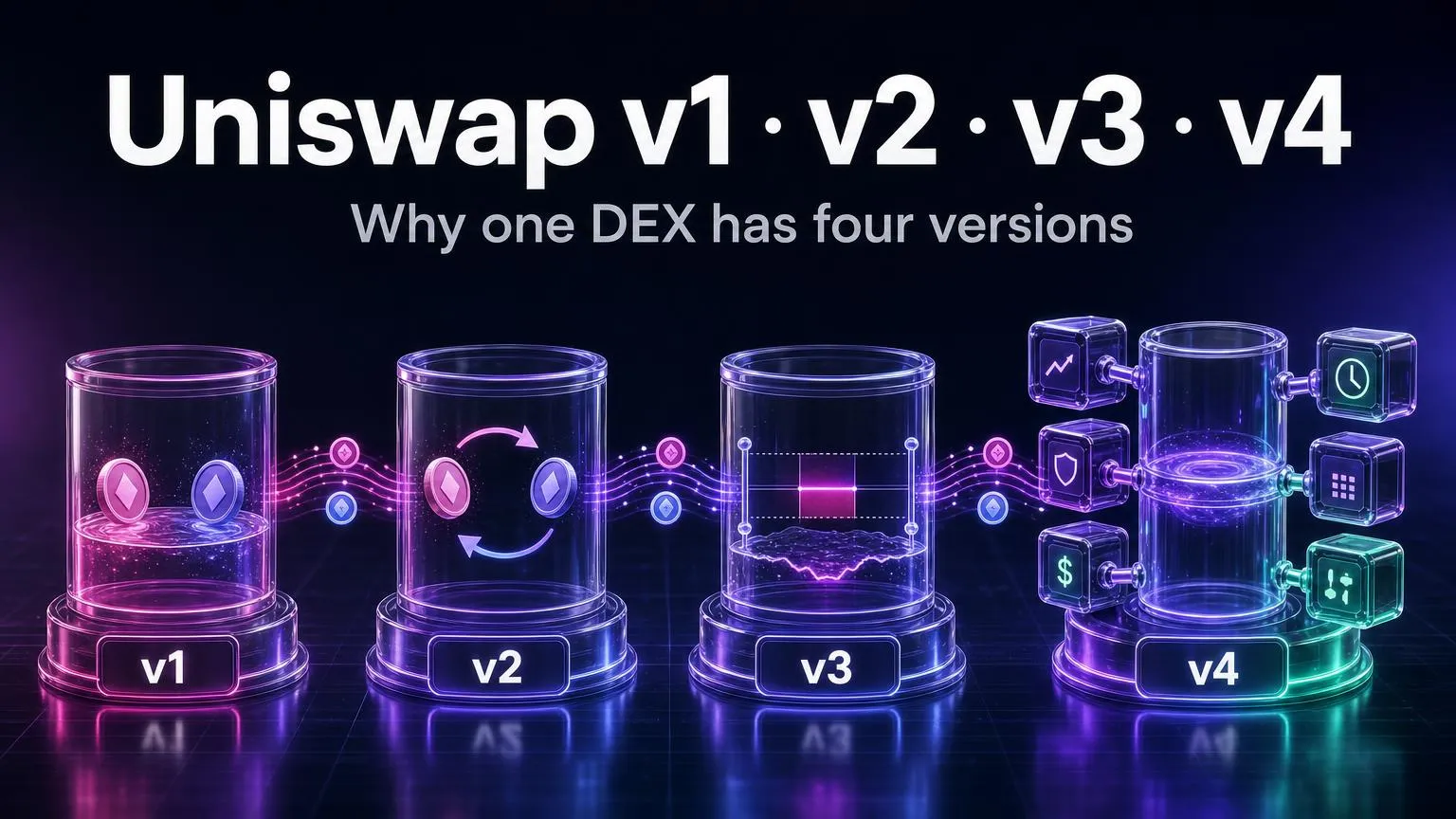
Open a token's pool list on Uniswap and you will often see the same pair several times, labeled v2, v3 or v4. Each label is a separate protocol with its own smart contracts, pools and liquidity. All four generations, from v1 in 2018 to v4 in 2025, still run at the same time.
This guide explains what each version changed, why the old ones are never switched off, how liquidity and volume split between them in October 2026, and what that means for traders, LPs and bulk trades on ChainTx.Tools.
The short answer
Uniswap contracts can't be upgraded. So instead of patching the protocol, the team ships a new one next to it, and liquidity providers (LPs) decide whether to move. Each version fixed a specific limit of the one before.
| Version | Launched | Key idea | Problem it solved | Share of TVL / 30-day volume* |
|---|---|---|---|---|
| v1 | Nov 2, 2018 | ETH ↔ token pools, x·y=k | An exchange with no order book and no gatekeeper | 0.1% / under 0.1% |
| v2 | May 18, 2020 | Any ERC-20 pair, price oracle, flash swaps | Token-to-token trades no longer route through ETH | 25.6% / 1.7% |
| v3 | May 5, 2021 | Concentrated liquidity, several fee tiers | Most capital in v2 pools was never used | 41.5% / 49.7% |
| v4 | Jan 31, 2025 | One contract for all pools, hooks, native ETH | Costly pool creation and multi-hop swaps, no way to customize pools | 32.8% / 48.6% |
*DefiLlama: TVL on October 11, 2026; volume from September 12 to October 11, 2026.
Uniswap v1: the proof of concept
Hayden Adams deployed the first Uniswap contracts to Ethereum on November 2, 2018, the last day of Devcon 4 (project history). The design was minimal. A factory created one exchange contract per token, always paired with ETH. Prices followed the formula x·y=k, so the bigger the trade relative to the pool, the more the price moved. Every swap paid 0.3% to liquidity providers. The weak spot was token-to-token trading: swapping USDC for DAI went through two pools, USDC→ETH and ETH→DAI, which meant two fees and two price impacts.
Uniswap v2: any pair, oracles and flash swaps
v2 went live on May 18, 2020 (launch post). The v2 whitepaper lists the main changes:
- any ERC-20/ERC-20 pair, so tokens can be paired directly;
- a price oracle: other contracts can read a time-weighted average price (TWAP) that is hard to manipulate within one block;
- flash swaps: take tokens from a pool and pay or return them by the end of the same transaction;
- an optional 0.05% protocol fee out of the 0.30%, which governance could turn on later.
v2 liquidity still covers the whole price range, from zero to infinity. That keeps it simple: deposit two tokens, receive LP tokens, and fees are added to the pool automatically. The downside is that most of that capital sits at prices the market never reaches.
Uniswap v3: concentrated liquidity
v3 launched on May 5, 2021 (launch post). Each LP now picks a price range, and their capital only works inside it. The docs give an example: the v2 DAI/USDC pool used only about 0.5% of its capital for trades between $0.99 and $1.01, where almost all the volume happened (docs). In v3, an LP can put everything into that band. The announcement claimed up to 4,000× better capital efficiency than v2.
v3 also introduced fee tiers of 0.05%, 0.30% and 1%. A 0.01% tier for stablecoins was added by governance in December 2021 (proposal 9). Positions became NFTs, because every range is unique. Fees stopped compounding into the pool and now have to be collected.
The cost is complexity. If the price leaves your range, the position becomes 100% one token and stops earning fees until the price returns. So v3 liquidity needs managing, either by hand or through a vault.
Uniswap v4: one contract, hooks and native ETH
v4 went live on January 31, 2025. The Uniswap Labs blog lists 10 networks at launch; the Uniswap Foundation lists 12 (Labs, Foundation). The liquidity math is the same as v3. What changed is the architecture around it (v4 vs v3):
- Singleton: all pools live in one
PoolManagercontract. Labs says creating a pool became up to 99.99% cheaper. - Flash accounting: only net balance changes are settled at the end, so a multi-hop route moves real tokens just twice.
- Native ETH: no wrapping into WETH.
- Flexible fees: any fee from 0% to 100%, or dynamic fees that change from trade to trade.
- Hooks: external contracts that a pool calls before or after swaps and liquidity changes.
A hook is a plug-in for a pool. It can raise the fee when volatility is high, run a token launch auction, manage an LP's range or restrict who can deposit. The hook is set when the pool is created and can't be changed, so a different hook means a different pool. Hooks are optional: a v4 pool without one behaves like a v3 pool.
Before launch, v4 went through nine audits, a $2.35M security competition and a bug bounty of up to $15.5M. The docs now call it the recommended version for new integrations (overview).
Why old versions keep running
The contracts are immutable. Core Uniswap contracts can't be upgraded, and nobody can pause them or reverse trades (docs). No admin key can move money from v2 pools into v4. When v2 was announced, the team wrote that v1 would keep working "for as long as Ethereum exists" (announcement).
Liquidity moves only when LPs move it. Each launch came with an optional migration tool, but many LPs had no reason to use it. v2 needs no attention, many older tokens keep their main pairs there, and other protocols are built around specific versions.
Routing hides the versions. Since December 2021 the Uniswap Auto Router has searched v2 and v3 pools together. It splits trades when that helps and adds a hop only if the result is better after gas (Auto Router v2). The Universal Router, launched in November 2022 together with the Permit2 approval contract, now combines v2, v3 and v4 swaps in one transaction (docs). UniswapX, launched in July 2023, adds signed orders. Competing "fillers" execute them and pay the gas, and a failed order costs the user nothing (docs).
In the Uniswap app, the router compares v2, v3, v4 and UniswapX for every trade. The version matters when you add liquidity, or when a tool sends your trade to one specific router.
Forks and licenses
- v2 is under GPL-3.0, so anyone could copy it. SushiSwap (August 2020) and PancakeSwap (September 2020) started as v2-style AMMs, and DefiLlama lists hundreds of v2 forks.
- v3 Core was under the Business Source License 1.1, which barred commercial copies until April 1, 2023 (LICENSE). PancakeSwap v3 appeared a few days later (The Defiant).
- v4 Core is also BUSL-1.1 and becomes MIT no later than June 15, 2027 (LICENSE).
That's why so many DEXes on BNB Chain, Polygon or Base feel familiar: underneath they use Uniswap's v2 and v3 router interfaces.
Uniswap in numbers (October 2026)
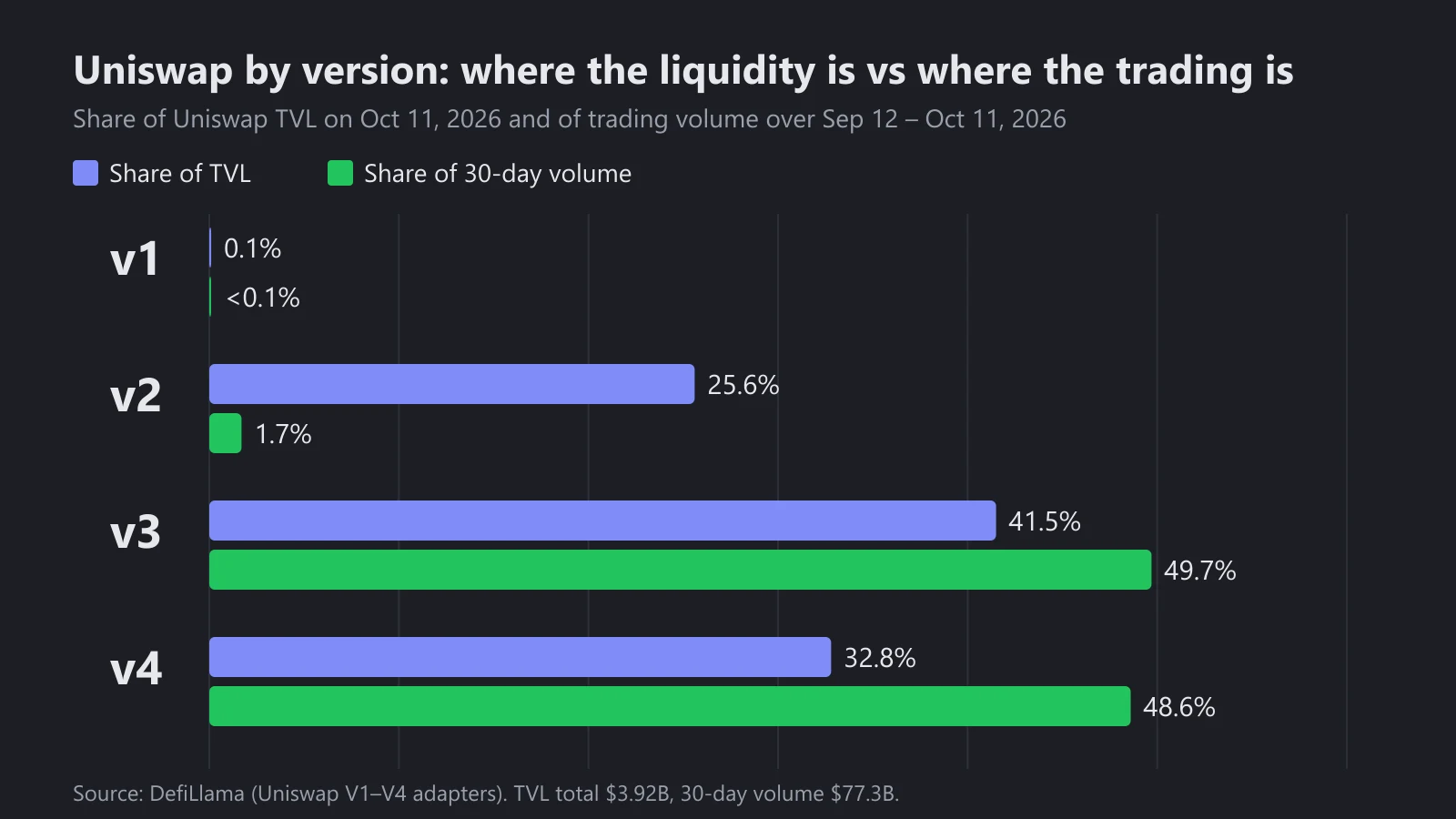
DefiLlama data as of October 11, 2026:
| Version | TVL | 30-day volume | Cumulative volume |
|---|---|---|---|
| v1 | $4.1M | $2.5M | $2.1B |
| v2 | $1.00B | $1.29B | $614B |
| v3 | $1.63B | $38.5B | $2.88T |
| v4 | $1.29B | $37.6B | $471B |
| Total | $3.92B | $77.3B | $3.96T |
- v2 holds a quarter of the liquidity but less than 2% of the trading. It's passive capital that nobody has a reason to move.
- v3 and v4 split the volume almost evenly. On Ethereum, v4 already takes 58%; on Arbitrum and Base, v3 still leads.
- By network, Robinhood Chain (live since July 1, 2026) produced 40% of Uniswap volume over those 30 days, Ethereum 32% and Base 10%. Uniswap's share of all DEX volume was about 27%.
- Cumulative volume. Uniswap Labs announced passing $4 trillion in early December 2025 (Phemex News). DefiLlama's count is lower, so say whose figure you quote.
Fee switch. The "UNIfication" proposal passed in December 2025 with 99.9% support. It burned 100 million UNI and turned on protocol fees (proposal 93, Labs blog).
- December 2025: v2 pools and the largest v3 pools on Ethereum.
- March 2026: all v3 pools on Ethereum, plus v2 and v3 on eight more networks.
- July 2026: selected types of v4 pools on seven networks (proposal 100).
- Early October 2026: fees were running on Ethereum and eleven other networks, and Arc was added (proposal 102).
Collected fees can only be claimed by burning UNI.
What the versions mean for traders and LPs
Fees. Where the fee switch is on, a v2 pool's 0.30% is split into 0.25% for LPs and 0.05% for the protocol. In v3, the protocol takes a quarter of the fee in the 0.01% and 0.05% tiers and a sixth in the 0.30% and 1% tiers (fee docs). The protocol share comes out of the LPs' cut, so traders pay the same total. In v4, though, a hook can add its own fee on top of the pool's.
Slippage. Concentrated liquidity makes pools deeper near the current price, but in a sharp move positions go out of range and that depth vanishes. A wide slippage tolerance keeps a trade from failing, but lets it fill at a much worse price.
Impermanent loss. In a v2 pool, if one token doubles against the other, the position ends up about 5.7% behind just holding both tokens (docs). A narrow v3/v4 range earns more fees per dollar but loses more when the price moves. A 2021 study of 17 v3 pools found that LPs earned $199.3M in fees and lost $260.1M to impermanent loss (Loesch et al.). A rough guide:
- v2: passive full-range liquidity, especially for volatile and tax tokens;
- v3: active ranges on liquid pairs, with the widest integrations;
- v4: like v3 without a hook, or with a hook whose code you trust.
Gas. A single swap costs about the same in every version. In Uniswap's own gas tests, a one-hop swap uses roughly 105,000–136,000 gas in v2, v3 or v4 (test snapshots). v4 saves on pool creation, multi-hop routes and native-ETH pairs, while a hook adds gas of its own.
Anyone can create a pool with any hook, and no one vets it by default. In May 2025 a bug in Cork Protocol's hook cost about $12M. In September 2025 a rounding error in Bunni's hook cost about $8.4M. Neither came from a flaw in v4 itself (Trail of Bits). In September 2026 the aggregator 0x reviewed 84,163 hooks on six networks and classified 54.2% as malicious, for example quoting one price and settling at a worse one. That is 0x's own estimate. Hayden Adams replied that routers should use only reviewed hooks, as Uniswap's own router does.
How ChainTx.Tools works with Uniswap versions
The EVM tools on ChainTx.Tools — bulk buy, bulk sell, multi-token buy and sell, and the EVM market maker — let you choose the DEX and version yourself. They don't aggregate across versions; every wallet trades through the router you select:
- Uniswap V2: the official Router02 with fee-on-transfer swap functions, so tokens with a transfer tax work.
- Uniswap V3: SwapRouter02. Before each trade the QuoterV2 contract checks the 0.01%, 0.05%, 0.3% and 1% pools and picks the best quote.
- Uniswap V4: the Universal Router, using only pools without hooks. Buying with the native coin needs no approval. The first sell of a token from a wallet needs a two-step approval (token → Permit2 → Universal Router); later sells don't.
The minimum output is always the quote minus your slippage. The versions on offer depend on the network: Base and Unichain, for example, have all three. The DEX list also includes Uniswap forks such as PancakeSwap, SushiSwap and QuickSwap.
First check where the token's liquidity actually is. If it trades only in a hooked v4 pool, as is common with some launchpads, the V4 option won't find it, so pick V2, V3 or another DEX. For a new token: deploy it with the token creator, add liquidity on Uniswap yourself, then run the bulk tools.
Summary
Uniswap has four versions because a protocol that can't be changed can only be improved by launching a new one next to it. v1 proved an on-chain AMM could work. v2 allowed any pair. v3 concentrated liquidity, which made it far more efficient but turned LPing into active work. v4 put every pool into one contract and made pools programmable through hooks. Old versions stay because their liquidity stays, and routers use all of them. In October 2026, v3 and v4 split the trading almost evenly, while v2 still holds a quarter of the liquidity. For a trader the version is mostly a routing detail. For an LP or a token team it is a choice between simplicity, efficiency and flexibility.
FAQ
+Which Uniswap version is the newest?
Uniswap v4 is the newest version. It went live on January 31, 2025, and the Uniswap docs call it the recommended version for new integrations. v2 and v3 keep running alongside it.
+Is Uniswap v2 still safe to use?
The v2 contracts are immutable and have run since May 2020, so the protocol itself keeps working as designed. The main risks are the usual ones: the token you trade, pool depth and slippage. In October 2026 v2 still held about a quarter of Uniswap's TVL, according to DefiLlama.
+Do I need to choose a version when I swap on Uniswap?
Usually not. In the Uniswap app the router compares v2, v3, v4 and UniswapX and can split a trade between them. The version matters when you add liquidity or use a tool that sends trades to one specific router.
+What are hooks in Uniswap v4?
Hooks are external smart contracts that a v4 pool calls before or after swaps and liquidity changes, for example to set dynamic fees or run a launch auction. A hook is fixed when the pool is created. Because anyone can deploy one, pools with unknown hooks carry extra risk.
+Why did forks of Uniswap v3 appear only in 2023?
Uniswap v3 Core was released under the Business Source License 1.1, which restricted commercial copies until April 1, 2023. After that date the code became GPL, and PancakeSwap v3 launched a few days later. Uniswap v2 had no such restriction, which is why its forks appeared back in 2020.
+What is the Uniswap fee switch?
It is a protocol fee taken from the LP share of swap fees, so traders pay the same total. Governance turned it on in December 2025 through the UNIfication proposal and extended it in 2026. Collected fees can be claimed only by burning UNI.
+Which Uniswap versions do the ChainTx.Tools trading tools support?
The EVM bulk buy, bulk sell, multi-token and market maker tools let you pick Uniswap V2, V3 or V4, depending on the network, plus forks such as PancakeSwap and SushiSwap. V4 trades go through the Universal Router and only use pools without hooks. The first sell of a token from a wallet needs a one-time Permit2 approval.