Stablecoins: USDT vs USDC and Other USD Stablecoins Explained
USDT and USDC both promise $1, but issuers, reserves, audits, freezes and regulation differ. We compare them with October 2026 data, explain GENIUS and MiCA, list other USD stablecoins by model and show transfer costs on Tron, Ethereum, Solana and BNB Chain.
 Antonio Vaganovs·Published ·12 min read
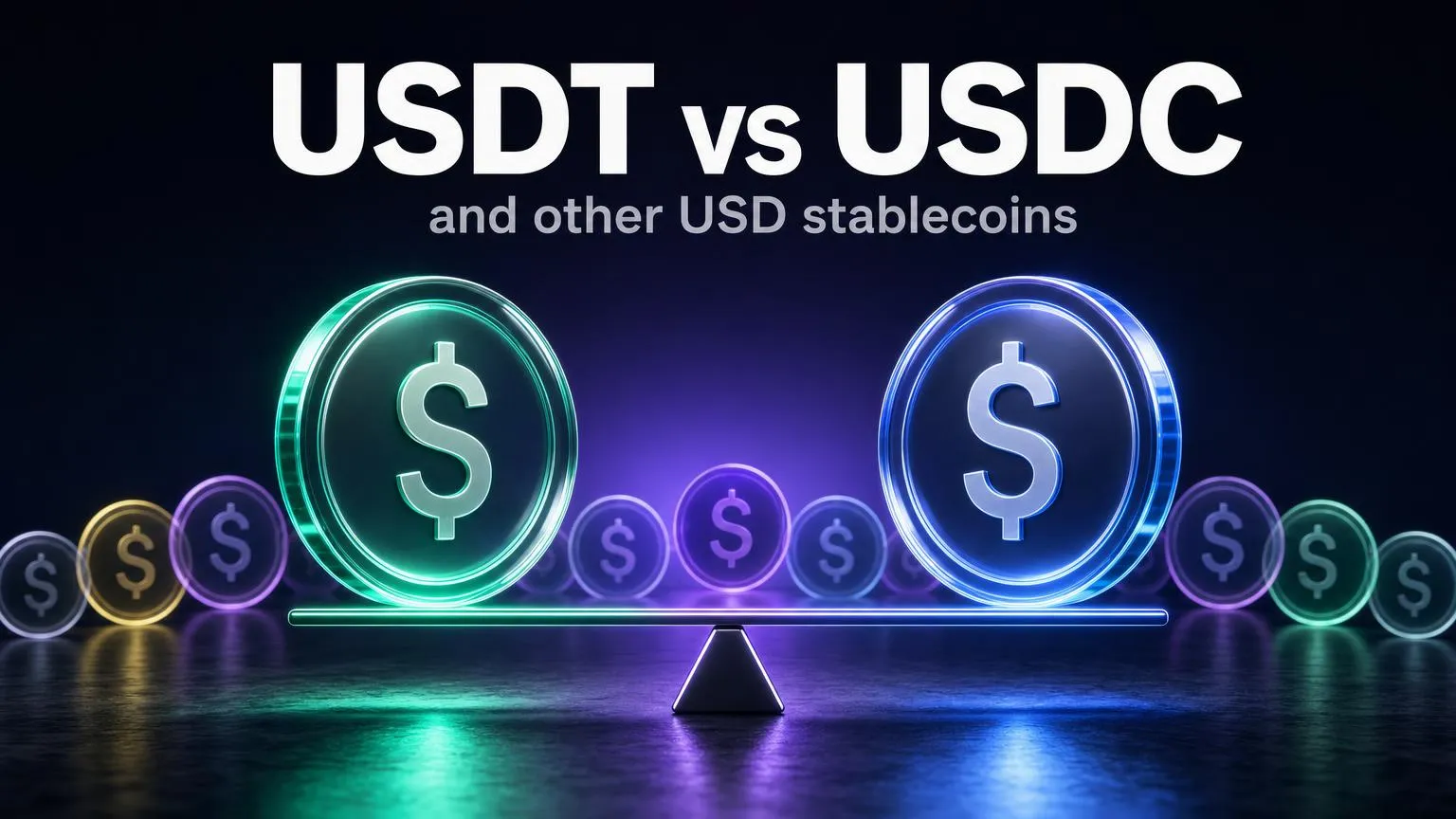
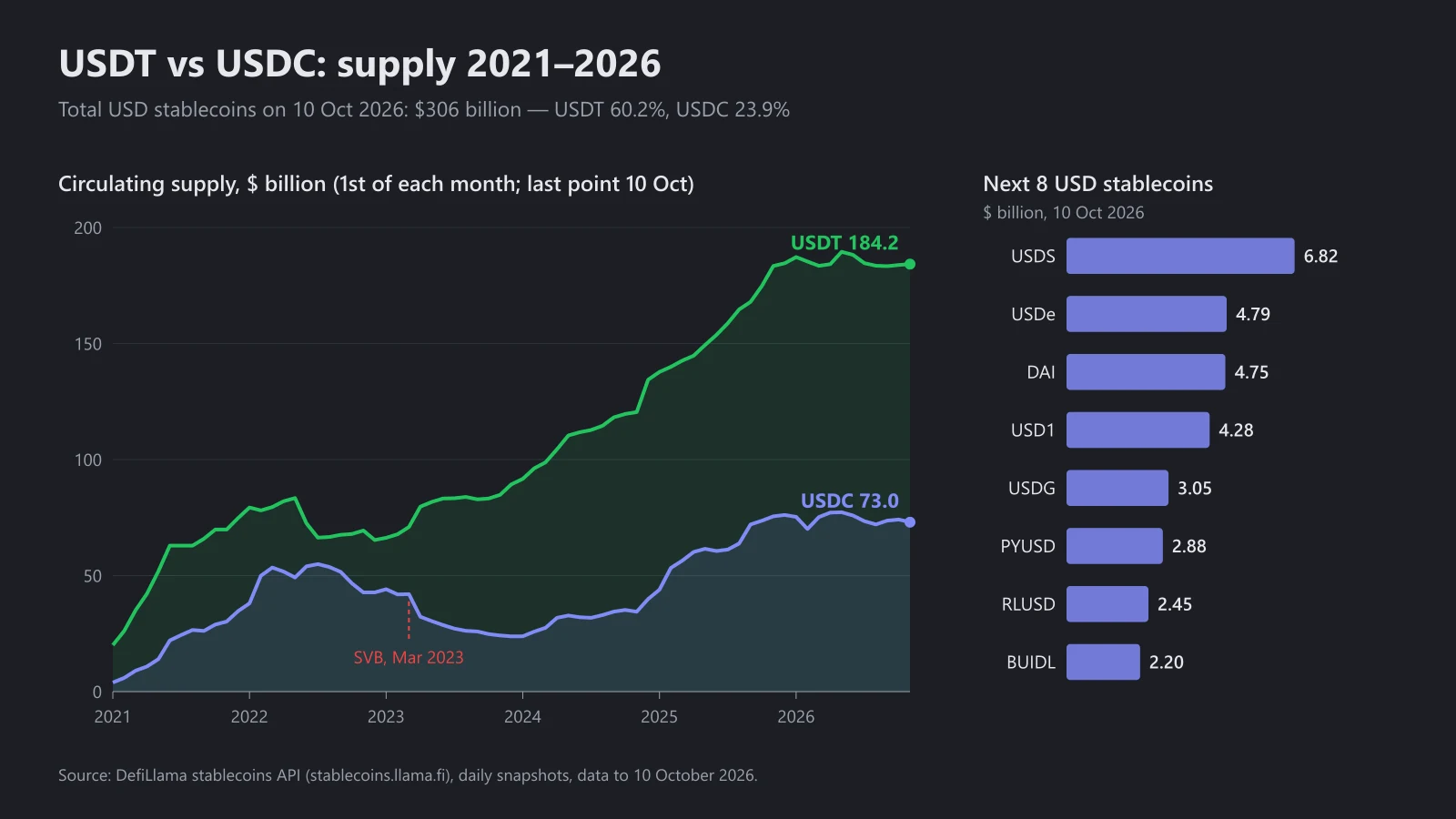
A stablecoin is a token designed to stay worth one unit of a real currency, almost always one US dollar. Of the $307.7 billion in stablecoins on 10 October 2026, $306 billion were dollar-pegged, and two tokens, Tether's USDT and Circle's USDC, held 84% of that (DefiLlama).
Both promise "1 token = $1", but the issuers, reserves, oversight and home networks are different. Below we compare the two, then look at the other USD stablecoins, transfer costs on each network and how to choose.
The short answer
| USDT (Tether) | USDC (Circle) | |
|---|---|---|
| Issuer | Tether group, headquartered in El Salvador | Circle Internet Group (US, NYSE-listed) |
| Since | 2014 | 2018 |
| Supply, 10 Oct 2026 | $184.2B, 60.2% of USD stablecoins | $73.0B, 23.9% |
| Main networks | Tron (51%), Ethereum (40%) | Ethereum (62%), Hyperliquid, Solana, Base |
| Reserves | T-bills and repo, plus gold, bitcoin, secured loans | Government money-market fund and bank cash |
| Reserve checks | Quarterly attestation (BDO); audit pending | Monthly attestation by a Big Four firm |
| Direct redemption | Verified clients, from $100,000 | Institutions via Circle Mint only |
| Can freeze addresses | Yes | Yes |
| EU (MiCA) | Not authorised | Authorised e-money token |
In short: USDT is the liquidity leader, especially on Tron and exchanges. USDC is the more transparent and more regulated option, the default in the EU, the US and most EVM DeFi.
How a fiat-backed stablecoin holds its peg
USDT and USDC are fiat-backed:
- An approved client wires dollars and the issuer mints tokens.
- The client returns tokens, and the issuer burns them and pays out dollars.
The dollars are invested in short-term assets, and the interest is the issuer's income.
Ordinary users trade on the market instead. Market makers who can redeem keep the price near $1: if USDT trades at $0.99, they buy it and redeem it for $1. So a peg is only as strong as the reserves and the redemption channel behind it.
An attestation confirms that on specific dates the reserves covered the tokens in circulation. A financial-statement audit examines the whole balance sheet, liabilities and internal controls over a period. Circle, as a listed company, has audited financials on top of monthly reserve attestations. Tether publishes quarterly attestations; its first full Big Four audit was announced in March 2026 and has not been published yet.
USDT: the biggest stablecoin
Issuer and history.
- The first tokens appeared in October 2014 on Bitcoin's Omni Layer.
- In January 2025 Tether announced the move of its headquarters to El Salvador.
Reserves. Tether's Q2 2026 report, as of 30 June and attested by BDO, shows:
- $187.75 billion of assets against $183.64 billion of liabilities;
- a $4.11 billion buffer, half the previous quarter's $8.23 billion.
Most of it is Treasury bills (about $115 billion) and reverse repo (about $25.6 billion), but Tether also holds:
- about 146 tonnes of gold (≈ $18.8 billion);
- about 98,900 BTC (≈ $5.8 billion);
- $13.45 billion of secured loans.
When gold and bitcoin fall, the buffer shrinks.
Track record. In 2021 the CFTC fined Tether $41 million, finding that in a 2016–2018 sample USDT was fully backed on only 27.6% of days. In May 2022, during the Terra collapse, USDT dipped to about $0.95, paid out billions in redemptions and recovered.
Redemption. Only verified clients can redeem: a $150 verification, a $100,000 minimum and a fee of 0.1% or at least $1,000 (fees). Everyone else exits through an exchange.
Networks. Tether issues USDT natively on 13 networks, including Tron, Ethereum, Solana, TON and Aptos. On many other chains you get USDT0:
- USDT is locked on Ethereum and minted 1:1 on the other chain through LayerZero's OFT standard.
- It has run since January 2025 and passed $100 billion of transfers by June 2026.
For the US market, Tether launched a separate token, USAT, in January 2026. It is issued by Anchorage Digital Bank under the new federal law, and its supply was $0.18 billion in early October.
USDC: the regulated alternative
History and licences.
- USDC launched in 2018 and has been fully controlled by Circle since 2023.
- Circle has been listed on the NYSE since June 2025.
- In the EU, USDC has been a MiCA e-money token since 1 July 2024, under a French licence.
- In August 2026 Circle reported final OCC approval of its national trust bank.
Reserves. Mostly in the Circle Reserve Fund, an SEC-registered government money-market fund managed by BlackRock, plus cash at large banks (transparency).
- There is no gold, bitcoin or lending.
- Holdings are disclosed weekly and attested monthly by a Big Four firm.
The SVB lesson. In March 2023, $3.3 billion of roughly $40 billion in reserves was stuck at the failed Silicon Valley Bank.
- USDC fell to about $0.88 and recovered once US authorities guaranteed the bank's deposits.
- Holders still left: USDC supply fell from $42.0 billion in early March 2023 to $23.2 billion in November (DefiLlama).
- It only returned above $70 billion in August 2025.
Redemption and networks.
- Direct redemption is only via Circle Mint, for exchanges and institutions.
- USDC is issued natively on 38 blockchains, and Circle's CCTP moves it between them by burning and minting, without bridge pools.
- In September 2026 Circle launched Arc, a network where USDC itself pays for gas.
Freezing and blacklists: both can, Tether does it more
Both contracts have an administrative switch:
- USDT has
addBlackListanddestroyBlackFunds, so Tether can freeze an address, burn its balance and reissue it to the victim or the authorities. - USDC has
blacklist.
The scale differs:
- In April 2026 Tether said it had frozen more than $4.4 billion across over 2,300 cases (Decrypt).
- An AMLBot study for 2023–2025 counted 7,268 blacklisted USDT addresses holding $3.29 billion, against 372 USDC addresses holding $109 million.
Nobody except the issuer can move a frozen balance. Funds received from a hacked or sanctioned address can get your address flagged too, so be careful with OTC deals and unknown counterparties. Freezing is now a legal duty as well: the US GENIUS Act requires issuers to be able to "seize, freeze, burn, or prevent the transfer" of tokens.
Regulation: GENIUS Act and MiCA
USA. The GENIUS Act, signed on 18 July 2025, requires:
- 1:1 reserves in cash, short Treasuries, repo or government money-market funds;
- monthly reserve reports checked by an accounting firm;
- an annual audit above $50 billion of issuance;
- no interest paid to holders.
It takes effect on 18 January 2027 at the latest; regulators missed their July 2026 rulemaking deadline. From 18 July 2028, US platforms may offer only stablecoins from permitted issuers, or from foreign issuers under regimes Treasury recognises as comparable.
European Union.
- USDC is MiCA-authorised; USDT is not.
- Coinbase, Crypto.com, Kraken and Binance delisted USDT, or restricted it to sell-only, for EEA users between late 2024 and March 2025.
- On 8 October 2026 ESMA went further: licensed providers must stop all services for non-MiCA stablecoins, custody and transfers included, and remediate existing positions within three months.
MiCA regulates issuers and service providers, not self-custody: you can still hold USDT in your own wallet. But expect EU-licensed exchanges and custodians to drop USDT entirely by early 2027, so convert or withdraw in time. For balances at EU platforms, USDC or EURC is the simplest choice.
Other USD stablecoins
Supply is from DefiLlama on 10 October 2026; freeze capability was checked in each token's contract code.
| Coin | Issuer | Model | Supply | Can freeze |
|---|---|---|---|---|
| USDS / DAI | Sky (formerly MakerDAO) | Overcollateralized crypto + RWA | $6.82B / $4.75B | No (USDS upgradeable) |
| USDe | Ethena | Synthetic: crypto + short perps | $4.79B | Token no; sUSDe yes |
| USD1 | World Liberty Financial, issued by BitGo | Fiat-backed | $4.28B | Yes |
| USDG | Paxos (MAS; MiCA in the EU) | Fiat-backed | $3.05B | Yes |
| PYUSD | PayPal, issued by Paxos | Fiat-backed | $2.88B | Yes |
| RLUSD | Ripple (NYDFS-regulated trust) | Fiat-backed | $2.45B | Yes, incl. clawback |
| BUIDL | BlackRock via Securitize | Tokenized money-market fund | $2.20B | Approved investors only |
| GHO | Aave DAO | Overcollateralized crypto | $0.70B | No |
| FDUSD | First Digital (Hong Kong) | Fiat-backed | $0.33B | Yes |
Fiat-backed coins work like USDC, and all of the ones above can freeze addresses.
Crypto-collateralized coins (DAI, USDS, GHO, crvUSD) are minted against excess crypto collateral and protected by liquidations.
- DAI's contract is immutable and cannot freeze.
- USDS has no freeze function, but it is upgradeable.
- They still lean on other stablecoins: DAI fell to about $0.88 during the USDC/SVB depeg.
Synthetic dollars like USDe hold crypto hedged with short futures, so their yield and risk depend on funding rates and exchanges.
- On 10 October 2025 USDe briefly traded near $0.65 on Binance alone while holding about $1 on-chain.
- Its supply has fallen from $14.8 billion that month to $4.8 billion.
Tokenized funds like BUIDL are investments for qualified investors, not payment coins.
Smaller issuers show the risks:
- FDUSD fell to about $0.87–0.91 in April 2025 after insolvency allegations against its custodian.
- In 2024 the SEC alleged that 99% of TrueUSD reserves had ended up in a speculative offshore fund.
Networks and transfer costs
Which coin is "the dollar" depends on the network (DefiLlama, 10 October 2026):
| Network | All stablecoins | USDT | USDC |
|---|---|---|---|
| Ethereum | $144.5B | $73.0B | $45.1B |
| Tron | $95.0B | $93.4B | ≈ 0 |
| Solana | $16.2B | $2.9B | $6.8B |
| BNB Chain | $14.5B | $9.2B | $1.6B |
| Base | $5.2B | ≈ 0 | $4.4B |
Tron is effectively a USDT chain: 98% of its stablecoins, with 23% growth over the year.
- A USDT transfer consumes roughly 65,000 energy, or about 130,000 if the recipient currently holds no USDT.
- Without staked or rented energy, Tron burns TRX at 100 sun per unit of energy (set by a network vote in August 2025). That is about 6.4 or 13 TRX, roughly $2.1 or $4.3 at the 10 October price.
Ethereum is cheap by its own standards: the base fee on 10 October 2026 was about 0.06–0.09 gwei, so a USDT or USDC transfer cost a few cents including the tip.
Solana charges 5,000 lamports per signature, about $0.0005. If the recipient has no account for the token yet, there is also a refundable rent deposit for the new account: 0.00148844 SOL (≈ $0.16) after the September 2026 rent cut, down from 0.00204 SOL.
BNB Chain costs a fraction of a cent: a median gas price of 0.05 gwei on 10 October and about 35,000 gas per transfer. But its USDT and USDC are Binance-pegged tokens with 18 decimals, not issued by Tether or Circle, and their contracts have no freeze function.
Many chains have several "USDT"s and "USDC"s: native, USDT0, bridged, exchange-pegged. Copy addresses from the issuer's site or a block explorer, never from a token search. One USDT is 1,000,000 base units on Tron or Ethereum but 10^18 on BNB Chain.
Risks and how to choose
- Issuer and reserves.
- USDC's reserves are plainer and checked monthly.
- USDT's include gold, bitcoin and loans, and its audit is pending.
- Smaller issuers have had real reserve problems (TUSD, FDUSD).
- Depegs. USDT slipped in 2022; USDC and DAI in 2023; FDUSD, and USDe on Binance, in 2025. The large fiat-backed coins recovered within days.
- Freezes. All large fiat-backed coins can freeze. Coins without a freeze function, such as DAI, carry collateral and governance risk instead.
- Regulation. USDT is being wound down at EU-licensed providers by early 2027. In the US, from 2028 only permitted or recognised issuers can be offered.
- Bridges. After the Multichain bridge was drained in July 2023, bridged USDC on Fantom traded around $0.50 (DL News). Prefer native tokens, CCTP or USDT0.
- Liquidity. Use what your network trades:
- USDT on Tron, TON and BNB Chain;
- USDC on Base, Solana DeFi and Hyperliquid;
- either on Ethereum.
For transfers and exchange deposits, pick the coin that is native and liquid on your network. For holding larger sums, especially in the EU or US, USDC's transparency and status make it the safer default. Yield-bearing dollars are investments, not cash.
Stablecoins in ChainTx.Tools
ChainTx.Tools handles any token by its contract address. You paste the contract (or the mint on Solana) instead of picking "USDT" from a list, and decimals are read on-chain. Just make sure the address comes from a reliable source.
- Payouts with One-to-Many:
- Consolidation with Many-to-One. Each source wallet also needs native coin for fees.
- Balances of hundreds of addresses with the Bulk Balance Checker, e.g. USDT on Tron. On EVM networks it can also show a balance as of a past date.
- Sweeping with Transfer All. On Solana it finds USDC, USDT and other SPL balances itself; elsewhere you list the token contracts.
- Exchange withdrawals to many addresses with CEX Bulk Withdrawal: nine exchanges, with the network (TRC20, ERC20 and others) chosen per withdrawal.
On Tron our tools pay for energy by burning TRX and do not rent it. Keep about 7–14 TRX per USDT transfer in each sending wallet, or stake or rent energy beforehand. For a step-by-step payout guide, see how to send crypto to hundreds of wallets.
Summary
USDT and USDC both target one dollar but make different trade-offs:
- USDT is bigger, rules Tron and exchanges, and backs itself with a bolder reserve under lighter oversight.
- USDC is smaller, more transparent and regulated, and the default in the EU and EVM DeFi.
Choose by network and liquidity first. Check the issuer, reserve reports and regulatory status before holding size. Always verify the contract address and decimals before sending.
FAQ
+What is the main difference between USDT and USDC?
Both are dollar-backed tokens, but USDT (Tether) is larger and dominates Tron and centralized exchanges, while USDC (Circle) is smaller and more regulated. USDC's reserves sit mostly in a government money-market fund and are attested monthly by a Big Four firm, while Tether's reserves also include gold, bitcoin and secured loans and are attested quarterly.
+Is USDT banned in the EU?
Holding USDT in your own wallet is not banned, because MiCA regulates issuers and service providers. However, USDT is not authorised under MiCA, major exchanges have delisted it for EEA users, and on 8 October 2026 ESMA told licensed providers to stop all services for non-MiCA stablecoins within three months.
+Can Tether or Circle freeze my stablecoins?
Yes. Both contracts have blacklist functions that block an address from moving its tokens. Tether has used this much more often: an AMLBot study counted 7,268 frozen USDT addresses in 2023–2025 versus 372 for USDC.
+Which is cheaper to send: USDT on Tron or USDC on another network?
Without staked or rented energy, a USDT transfer on Tron burns roughly 6.4 to 13 TRX, a couple of dollars at October 2026 prices. On Solana or BNB Chain the network fee is a fraction of a cent (Solana adds a refundable deposit if the recipient has no token account yet), and on Ethereum it was a few cents in October 2026. With staked or rented energy, Tron becomes much cheaper.
+Why does USDT on BNB Chain have 18 decimals?
The USDT and USDC on BNB Chain are Binance-pegged tokens, not issued by Tether or Circle, and they use 18 decimals instead of the usual 6. ChainTx.Tools reads decimals on-chain, but always double-check amounts when moving funds between networks.
+Are yield-bearing stablecoins like sUSDe or sUSDS the same as USDT?
No. They are investment products whose yield comes from funding rates, lending or protocol revenue, and they carry extra risks. Under the US GENIUS Act, issuers of payment stablecoins may not pay interest to holders.
+How do I send USDT to many wallets at once?
Use the One-to-Many bulk sender on ChainTx.Tools for your network and paste the token contract address, for example the TRC-20 USDT contract on Tron. On Tron, keep enough TRX in the sending wallet to pay for energy for every transfer.